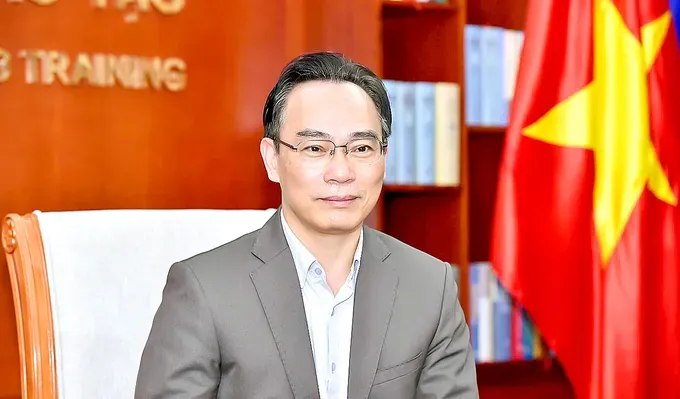
The education and training sector is about to enter the 2026-2027 academic year. Minister of Education and Training Hoang Minh Son discussed the sector’s prolonged issues and actionable solutions.
The past school year was the first to implement the Politburo’s Resolution No. 71-NQ/TW on educational development breakthroughs. The entire sector has made immense efforts and achieved numerous crucial results.
However, there’re still lingering shortcomings. Educational access and quality remain uneven across regions; localized teacher shortages persist; and overcrowded classrooms are still being reported in some areas where facilities simply don’t meet requirements. More seriously, incidents related to school violence, teacher ethics violations, exam fraud, overcharging, improper extra classes, and the “achievement obsession” are still occurring.
Besides, the quality of higher education and vocational training hasn’t kept pace with developmental demands. High-quality human resources are still lacking, especially in basic sciences and strategic technologies. Those are the exact problems that need focusing on in the new school year.
Classroom overcrowding and early-grade admission pressures remain urgent bottlenecks. In rapidly surging metropolitan and industrial zones, educational infrastructure simply hasn’t caught up. Furthermore, uneven school quality spikes demand for specific institutions, ramping up admission stress.
To kick off a fundamental fix, authorities must synchronously plan school networks and forecast learning demands alongside urban development. Encouraging private sector investment in school construction is also crucial. Alongside boosting capacity, narrowing the quality gap by rotating teaching staff and effectively implementing vocational secondary school models will help students choose suitable paths.
The Ministry of Education and Training will guide provinces to vigorously revamp early-grade admissions next year. By shifting towards digital map zoning based on distance, students will basically learn at the most convenient locations without grueling entrance exams, thereby fundamentally alleviating stress at the end of the day.
For Minister Hoang Minh Son, the impending reorganization of the educational facility network must pivot towards elevating operational quality and optimizing resources. It absolutely shouldn’t diminish learners’ access to classrooms.
Regarding general education, authorities need to comprehensively calculate population scale, traffic, and accessibility. They shouldn’t rigidly apply a one-size-fits-all model. It appears that under favorable conditions, allocating one primary, middle, and high school per commune is entirely feasible.
In smaller, closely connected areas, schools can be merged to utilize facilities more effectively. However, in remote regions, special attention must be paid to travel safety. Slashing management focal points doesn’t mechanically translate to reducing satellite campuses.
For public higher education and vocational institutions, reorganization helps remedy systemic fragmentation. It needs to maximize each facility’s strengths, elevating governance and research capacities to align with national human resource demands.
Restructuring the organization is merely the first step to get the ball rolling. More importantly, governance, staff, and curricula must be overhauled to forge genuine effectiveness. What can be expected is a leaner apparatus that runs more efficiently, where resources are utilized better, and where learners as well as educators truly reap the benefits.
Over the next two years, the Ministry will closely monitor these impacts to promptly adjust emerging issues. After all, restructuring is only meaningful if students study in better conditions.
The Minister emphasized the “reducing to increase” motto where slashing mere formalities boosts feasibility. By cutting overlapping contents, educators can definitively free up resources and time for more valuable endeavors.
Minister Hoang Minh Son then discussed what the education sector will do to solidify societal trust in the face of recent negativities regarding exams, overcharging, the achievement obsession, and improper extra classes.
Firstly, the education and training sector must frankly acknowledge the negative incidents that have eroded public trust. Each case must be reviewed and handled strictly according to regulations. Simultaneously, it’s crucial to identify management loopholes to rectify them and prevent recurrences. However, handling violations is just one piece of the puzzle.
More importantly, there’s a need to build an educational environment that champions honesty, responsibility, and genuine quality. Testing and assessment must accurately reflect learner capacity; collected fees must be public, transparent, and compliant; extra teaching and learning must adhere to rules; and emulation movements must target real quality instead of chasing superficial achievements.
Trust doesn’t come from mere words but is forged through how functional agencies handle shortcomings and tangible transformations in education. When parents confidently send their kids to school, students learn in a safe, fair, and honest environment, and educational outcomes are trusted by society, that is the clearest metric.
The spirit of “real learning, real exams, real talent, real values” will be concretized starting next school year. It starts with properly executing the fundamental principles of education, beginning with daily tasks and doing them consistently.
- Real learning is studying with high effort to understand deeply, apply creatively, and make genuine progress, not just to score high marks or grab a diploma.
- Real exams mean accurately assessing learner capacity while ensuring honesty, objectivity, and fairness.
- Real talent belongs to those who truly possess the capability, character, and ability to contribute.
- Real values are the substantive merits and long-term benefits that education brings to the learner and society.
Standing on those fundamental principles, the Ministry is urgently drafting a concrete action plan for sector-wide rollout next year. This spirit can’t stop at education, propaganda, or mobilization; it must manifest in every daily school activity. from curriculum development, teaching methodologies, and testing to innovating school governance, school-family relations, pedagogical conduct, and reward systems. Everything must pivot towards genuine quality and effectiveness.
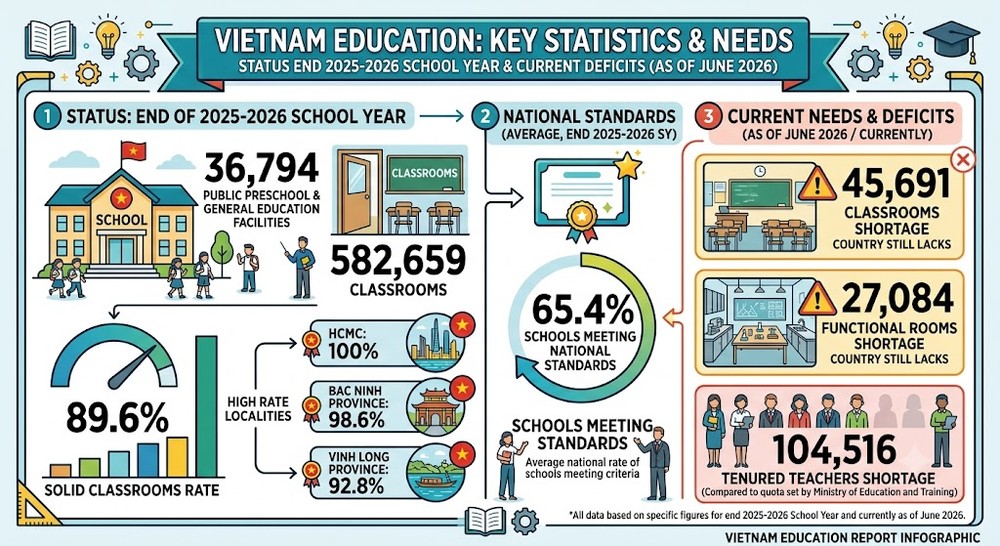
By the end of the 2025-2026 school year, Vietnam had 36,794 public preschool and general education facilities with a total of 582,659 classrooms, while the rate of solid classrooms reached 89.6 percent. Some localities achieved high rates, such as HCMC hitting 100 percent; Bac Ninh Province reaching 98.6 percent; and Vinh Long Province at 92.8 percent. The national average rate of schools meeting national standards stood at 65.4 percent.
Currently, the country still lacks 45,691 classrooms and 27,084 functional rooms. As of June 2026, the entire nation is short of 104,516 tenured teachers compared to the quota set by the Ministry of Education and Training.