Unseen battlefield
Following the 1954 Geneva Accords, the nation was temporarily divided. The North became the great rear, a heartland that not only nurtured the dream of unification but also had to steel itself against an onslaught of sabotage plots from across the demarcation line.
The once-quiet villages, towns, and forests were no longer sanctuaries of peace; the threat of infiltrating spies and commandos could materialize at any moment. In this tense climate, building a “battlefield of airwaves” to detect and neutralize every hostile signal became a mission of survival.
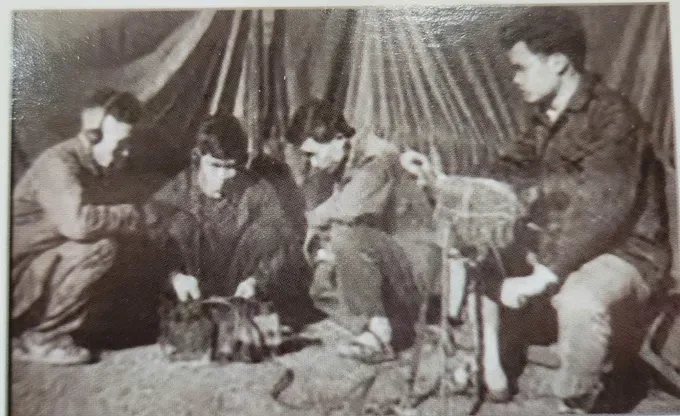
Behind the headphones and telegraph machines lay the lives and destiny of the entire North. According to historical records from the public security sector, a pivotal moment occurred on July 1, 1954. In a small hamlet in Tuyen Quang Province, Minister of Public Security Tran Quoc Hoan met with five technical officers, assigning them a special mission and officially establishing a unit codenamed “MATH” – an acronym for “Ma Tham”, or code reconnaissance.
“The enemy is currently trying every method to spy, establish reactionary bases, and drop commandos into our rear”, the Minister instructed. “Therefore, using radio technology to gather intelligence and combat espionage is of immense value.”
In response to the U.S. green-lighting its “Secret War” against North Vietnam on May 11, 1961, the Ministry of Public Security acted swiftly. It established a comprehensive radio communications system in Hanoi, complete with powerful transmitters, receivers, and a secure Teletype team to ensure a continuous flow of information between central command and provincial police.
This was far more than a simple communications network; it was the eyes and ears of the technical counterintelligence force. From a strange signal captured on the airwaves, a voice lost in the static, or a fragmented piece of code, these specialists could unravel an entire spy ring. On this battlefield without gunshots, every operator was a soldier, and every successfully decoded signal was a silent, priceless victory.
Two hands on key, two ears on airwaves
In small rooms humming with the crackle of electrical pulses, radio counterintelligence soldiers sat patiently, their hands deftly tapping out the familiar “dit-dah” of Morse code, their ears strained to catch the faintest signal. Each shift was a silent battle of wits where a single moment could determine the fate of an entire operation.
The center was organized into a relentless 24/7 rotation, with specialized teams for detection, research, mobile reconnaissance, and signal positioning. No one left their post until relieved; the mission demanded absolute precision, every second of every day.
The Morse telegraph was their constant companion. The operator had to skillfully manipulate an electrical circuit to create the short and long signals, maintaining perfect rhythm and accuracy. For these soldiers, the sound of the telegraph was not just a stream of information but the very “heartbeat of the battlefield”. A single signal lasting only two or three seconds could be the crucial clue needed to pinpoint an enemy’s location. A moment’s hesitation or a minor error, and the signal as well as the opportunity would be lost forever.
Senior Colonel Nguyen Ngoc Trac, former leader in what is now the Ministry of Public Security’s Department of Professional Technical Operations (A06), recalled the intense focus required, as hostile signals could last a mere three to five seconds. “In that brief window”, he said, “the report had to be relayed instantly.” For stealthy sea-based teams, operators often had only a single two-second signal to work with, requiring flawless coordination to pinpoint their location.
Amidst a scarcity of modern equipment, the diligence and ingenuity of these soldiers became the most advanced “technology” available. “Because of the nature of the work, which demanded absolute accuracy and secrecy, my family only knew I had a job”, Senior Colonel Trac recounted. “They had no idea what I did or where. To get the job done, our units worked shoulder-to-shoulder, second by second. A soldier on duty had two ears: one for orders from central command, the other for catching the enemy’s signal to report it down the line.”
In this silent war, each “dit” and “dah” was more than an electronic pulse; it was a warning, an arrow guiding the steps of reconnaissance teams across the country, where other battles of wits were constantly unfolding.
Creating static, sowing confusion
In the world of radio waves, the battle was not always about clear signals. Often, it was a silent contest of deception, a chase between Vietnamese operators’ wits and the enemy’s tradecraft. Case File KS16, codenamed “Tornado”, was one such battle, where every captured signal and every fabricated burst of static became a soft weapon to lure the enemy into a carefully laid trap.
On May 16, 1962, the eight-man “Tornado” commando team was captured immediately upon parachuting into Son La Province thanks to prior intelligence. This began Case File KS16. North Vietnamese forces then reactivated the team’s radio, skillfully deceiving the enemy’s command center. They successfully navigated a secondary password request: “How many colors do your shoes have?”, leading the enemy to commend the captured team’s “success” with a medal.
From 1966 to 1968, a steady stream of fabricated reports detailing sickness, floods, and starvation was sent, causing the enemy to abandon the operation. “Tornado” was a major, silent victory in a long battle of wits.