Universities in Ho Chi Minh City are translating Politburo Resolution 57-NQ/TW into action by linking research with business needs and developing roadmaps to commercialize knowledge. To turn these policies into practical value, funding, technology transfer support and cooperation mechanisms need to be addressed soon.
Universities pivot toward applied researches under Resolution 57
Politburo Resolution 57-NQ/TW identifies scientists as a key factor and places people and businesses at the center, while calling for universities to become strong research entities that link research with applications and training. For universities, the challenge is how to organize resources so knowledge can reach those who need to use it.
University of Economics Ho Chi Minh City (UEH) has introduced the UEH100 initiative, a strategic program designed to recruit 100 international scholars and establish advanced research, technology, innovation, and Living Labs. According to Assoc. Prof. Bui Quang Hung, who is the school director, the framework is engineered to bridge academia with industry, government bodies, and local communities, fostering a dynamic ecosystem where empirical research directly tackles pressing socio-economic challenges.
The development roadmap is divided into stages. From 2026 to 2030, the university will establish strong research groups and increase applied research. From 2031 to 2035, it will promote knowledge commercialization and develop spin-off companies. Placing commercialization on a long-term roadmap highlights the need to prepare human resources, research capacity and market connections at the same time.
At Ton Duc Thang University, the foundation for this direction includes 11 strong research groups, specialized laboratories, a high-performance computing system and 15 patents granted by the United States Patent and Trademark Office. These capabilities have been built up to enable the university to further promote applied research and commercialization.
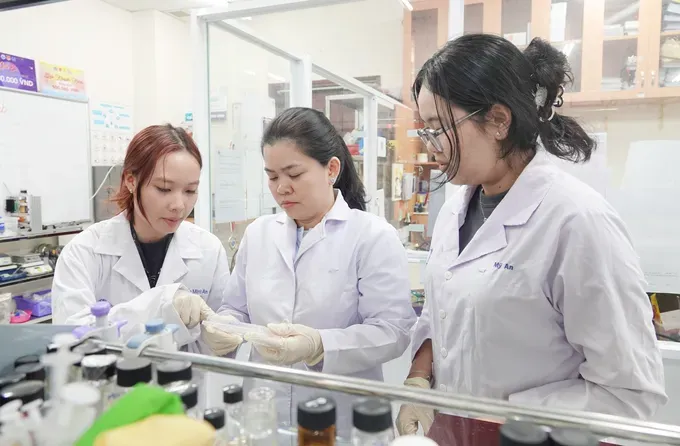
Assoc. Prof. Tran Trong Dao, the university's principal, said Resolution 57-NQ/TW provides a framework for universities to strengthen their role in the science, technology and innovation ecosystem. The university is developing research in AI, semiconductors and biotechnology while promoting links among universities, the Government and businesses. Universities are not only tasked with training high-quality human resources but must also become places that create new knowledge, new technologies and innovative value for society.
Universities addressing bottlenecks at every stage of technology transfer
According to many experts, research capacity alone does not guarantee technology will reach the market. To bring research results to market, universities need to organize effective connections with businesses, provide technology transfer support and create conditions for scientists to pursue long-term research.
Assoc. Prof. Nguyen Thi Hiep, head of the Faculty of Biomedical Engineering at the International University under Vietnam National University Ho Chi Minh City, once had to discuss the matter with her family and save part of her personal income and teaching earnings to sustain her research.
Drawing on her experience after returning to work in Vietnam 14 years ago, she said Resolution 57-NQ/TW and Resolution 193/2025/QH15 have opened a clearer path, helping scientists see the country's needs and giving them greater confidence to pursue research. She has also actively encouraged young Vietnamese professionals overseas to return and recruited additional talented staff.
In seeking applications for research results, Assoc. Prof. Nguyen Thi Hiep encountered situations in which businesses had needs and scientists had technologies, but the two sides still could not develop a finished product. Businesses needed to address a specific production bottleneck, while scientists wanted to pursue broader ideas from the laboratory. Therefore, she said cooperation should begin with visits to factories to identify problems and solve them one by one, thereby creating value and building trust.
The female head of the Faculty of Biomedical Engineering at the International University said universities need intermediary teams that understand technology, business needs and legal regulations. These teams can identify existing technologies and find places where they can be applied, while also bringing problems from businesses and localities back to universities to help shape research from the outset.
However, while they are not afraid of conducting research, they are certainly concerned about disbursement procedures. Flexible financial procedures and timely funding are therefore needed so scientists can remain confident in pursuing their work.
From a university management perspective, Professor Mai Thanh Phong, Principal of the Ho Chi Minh City University of Technology under Vietnam National University Ho Chi Minh City, said the university has seven research and technology transfer centers and two science and technology companies. Revenue from services and technology transfer has risen from VND70 billion-VND80 billion (US$2.68-3.07 million) a year five years ago to about VND150 billion a year, reaching nearly VND200 billion at times. These results accumulated over many years provide a foundation for implementing Resolution 57-NQ/TW, although the exploitation of patents remains modest.
Research at universities is still reflected mainly through academic papers, while commercialization remains below its potential. Removing institutional bottlenecks and increasing investment in applied research are key factors. Ho Chi Minh City needs to encourage businesses to invest in technology, prioritize funding for applied research and facilitate the establishment of research and development (R&D) centers on university campuses.
Scientific research in higher education institutions must extend beyond describing current realities to actively contributing policy proposals, intervention models, and actionable solutions. When research aligns with genuine societal needs, universities cease to be academic ivory towers and evolve into socially responsible knowledge centers.
— Prof. Huynh Van Son, Principal of Ho Chi Minh City University of Education