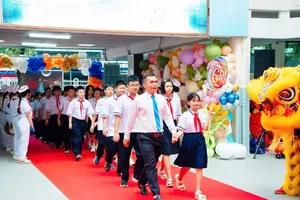
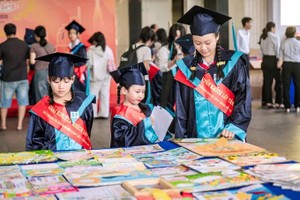
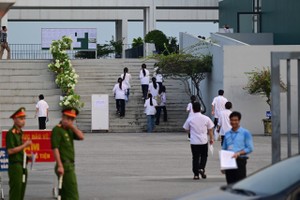
On the morning of August 27, the Government held a conference to review the 2025-2026 school year and roll out tasks for the 2026-2027 school year. The conference was held in person at the Government Office and connected online to meeting points at the People's Committees of 34 provinces and cities.
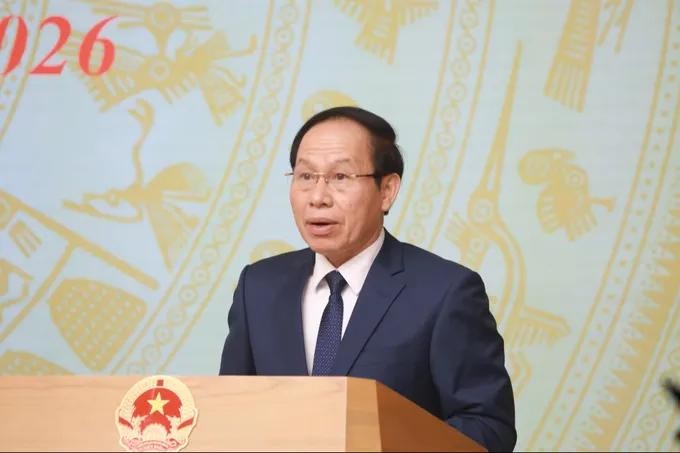
The conference was chaired by Prime Minister Le Minh Hung. Attending at the central meeting hall were Deputy Prime Minister Le Tien Chau, Minister of Education and Training Hoang Minh Son, and leaders of ministries and agencies. At the provincial and municipal meeting points were local leaders and leaders of relevant departments, agencies and organizations.
The conference to review the 2025-2026 school year and implement tasks for the 2026-2027 school year is being held as the country prepares to enter the first school year following the 14th National Party Congress, while marking one year since the implementation of Politburo Resolution No. 71-NQ/TW on breakthroughs in education and training development.
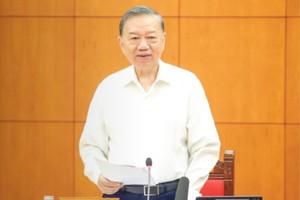
In his opening remarks, Deputy Prime Minister Le Tien Chau stressed that the overarching task for the 2026-2027 school year must be to make a strong shift from institutional development to effective implementation, from administrative management to development-oriented governance, and from organizational mechanism reform to substantive changes in every school and classroom. Every policy and measure must be assessed based on learners' progress, teachers' confidence and the quality of human resources.
The Deputy Prime Minister asked localities to ensure adequate schools, classes and teachers, as well as appropriate governance arrangements for schools with multiple levels and campuses after restructuring. At the same time, they should implement measures to reduce internal procedures, paperwork and records, as well as unnecessary meetings; strictly address the pursuit of achievements, examination and enrollment fraud, distortions in extra teaching and learning, and excessive collections at the beginning of the school year; and tackle issues of public concern such as ethics, psychology, nutrition, drugs and school violence.
Regarding the restructuring of higher education and vocational education institutions, he called for a review and urgent completion of the restructuring roadmap, with greater substantive autonomy to strengthen links among the State, schools and businesses.
The Deputy Prime Minister stressed that reducing the number of units or personnel should not be considered an achievement. More importantly, the focus should be on improving training quality and concentrating resources on developing a number of elite universities and high-quality training institutions of regional and international standing to meet human resource development requirements in the new context.

Regarding the status and quality of the teaching workforce, the Deputy Prime Minister emphasized that teachers are the decisive factor in training quality. Therefore, comprehensive solutions are needed not only for salaries and allowances but also for honoring teachers, protecting their professional reputation, improving working conditions, and enhancing their capacity, ethics and sense of responsibility. Recruitment, utilization, evaluation and workforce allocation should also be reformed to ensure teachers are respected by society and can devote themselves to their work.
A projected reduction of 32,625 principals, vice principals, 11,041 staff
According to a report on the implementation of tasks for the 2025-2026 school year and key tasks and solutions for 2026-2027 presented by Standing Deputy Minister of Education and Training Pham Ngoc Thuong, as of August 20, 16 localities had basically completed the restructuring. The process is expected to be completed nationwide before August 30.
The number of educational institutions is expected to fall from 37,515 to 18,575, a reduction of 50.5 percent.
The restructuring will also facilitate the redeployment of personnel. An estimated 32,625 principals and vice principals and 11,041 staff members will be eliminated, with many education managers reassigned to teaching positions.
As a result, the number of teacher positions expected to be added for the 2026-2027 school year will fall from 104,516 to 43,267, equivalent to the number of teacher positions allocated in 2025 that remain unfilled and nearly equal to the number of teachers currently working under contracts.
The Ministry of Education and Training said the requirement for the 2026-2027 school year is to quickly turn policies into action, policies into results, and resources into substantive education quality.
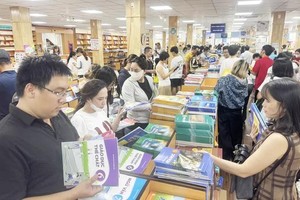
The program to build boarding schools with multiple education levels in border communes is being implemented aggressively. The first 108 schools are expected to be put into use at the beginning of the new school year, adding 4,396 classrooms and 102 libraries and ensuring learning conditions for about 113,000 students. From the 2026-2027 school year, a unified set of general education textbooks will be used, with the average selling price reduced by 13.3 percent.
According to the report, localized shortages and surpluses of teachers have not been fully addressed. After the restructuring, the education sector is forecast to need about 43,267 additional teacher positions for preschool and general education in the 2026-2027 school year, while 44,770 allocated positions remain unfilled and about 48,374 teachers are working under contracts.
Infrastructure also remains limited. Nationwide, there is still a shortage of about 45,691 classrooms and 27,084 specialized classrooms. In disadvantaged areas, 6,477 classrooms are borrowed or temporarily used, while the average availability of minimum teaching equipment is only about 50.6 percent.
Seven key tasks
For the 2026-2027 school year, the education sector has adopted the theme: “Innovate Thinking – Make Strong Progress – Deliver Substantive Results”. The focus is on shifting strongly from institutional development to implementation, addressing bottlenecks and measuring results through learners' progress, teachers' working conditions, school performance and the quality of human resources.
The education sector will focus on seven key groups of tasks, including a major reform of education governance and addressing bottlenecks involving the teaching workforce and infrastructure.
It will also reduce unnecessary paperwork and meetings, reform examinations and assessments, tighten discipline in examinations and enrollment, properly manage extra teaching and learning as well as revenues and expenditures, strengthen psychological counseling, school healthcare and food safety, prevent violence and abuse, and protect children in the online environment.
The sector will also complete the model for high school graduation examinations and university and college admissions to ensure a streamlined and substantive system while preventing fraud and misconduct.
In the 2025-2026 school year, about 4.82 million preschool children and 19.08 million general education students attended school. The number of students entering 10th grade in the 2026-2027 school year increased by more than 24 percent from the previous year.