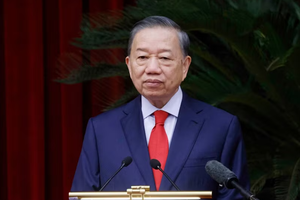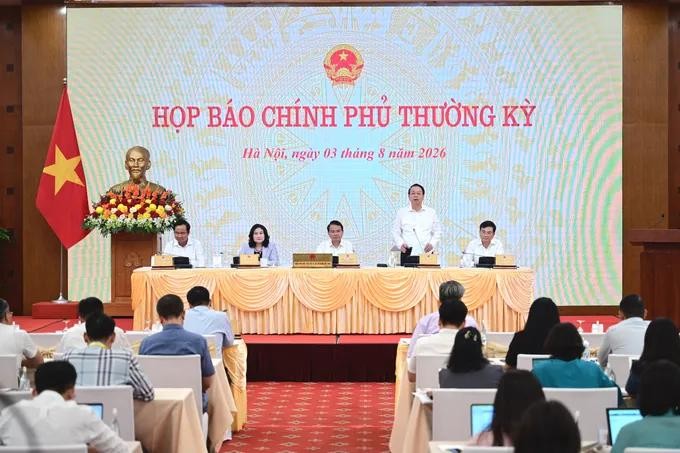
Prime Minister Le Minh Hung has directed ministries and local authorities to aggressively implement measures to achieve double-digit economic growth, accelerate the allocation and disbursement of public investment funds particularly at ministries and agencies with disbursement rates below 10 percent and ensure that 100 percent of the annual public investment plan is disbursed.
The directives were announced at the Government's regular monthly press conference for July, held in Hanoi on the evening of August 3 by the Government Office.
According to Dang Xuan Phong, Minister and Chairman of the Government Office, Prime Minister Le Minh Hung chaired the Government's regular July meeting earlier that day to review the country's socio-economic performance in July and the first seven months of 2026, public investment allocation and disbursement, and the implementation of national target programs.
Providing details of the meeting, Minister and Chairman of the Government Office Dang Xuan Phong said Vietnam's socio-economic situation remained broadly stable during July and the first seven months of the year. The consumer price index (CPI) is estimated to have fallen 0.1 percent in July from the previous month, while average inflation for the January–July period is estimated at 4.38 percent to 4.39 percent.
State budget revenue is estimated at VND1.83 quadrillion (US$69.6 billion), equivalent to 72.5 percent of the annual target.
Public investment disbursement through the end of July is estimated at VND418.9 trillion, reaching 41 percent of the annual plan. This represents an increase of VND77.7 trillion in absolute terms and about 2.7 percentage points compared with the same period last year.
Foreign direct investment (FDI) remained a bright spot, with newly registered capital estimated at US$36.36 billion, up 50.9 percent year-on-year, while realized FDI reached US$15.2 billion, up 11.8 percent. Total import-export turnover for the first seven months was estimated at US$659.6 billion, an increase of more than 28 percent from a year earlier.
Government members also identified several challenges requiring attention, including industrial, services, and construction growth falling short of targets; seven consecutive months of trade deficits; external trade remaining heavily dependent on the FDI sector and a limited number of markets; slow public investment disbursement at some ministries, sectors, and localities; and rising lending interest rates putting pressure on financial and monetary markets.
Summarizing the meeting, Mr. Dang Xuan Phong said the Prime Minister stressed that while the tasks ahead are demanding, Vietnam also has significant opportunities stemming from strategic policies recently adopted by the Party Central Committee. Ministries, agencies, and localities were urged to build on existing achievements and maximize new development opportunities.
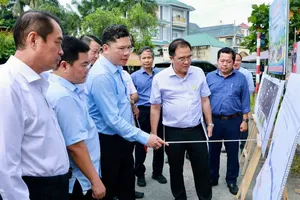
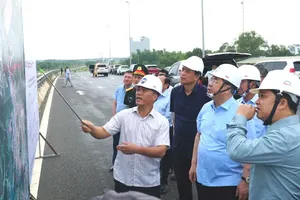
The Prime Minister ordered decisive implementation of measures to promote double-digit economic growth, accelerate public investment allocation and disbursement, particularly at ministries and agencies with disbursement rates below 10 percent, and ensure full disbursement of the annual investment plan.
He also instructed authorities to implement measures to stabilize lending interest rates, ensure liquidity for the economy, maintain stability in the monetary and foreign exchange markets, and strictly handle unfair interest-rate competition.
The Prime Minister called for credit growth to be managed in line with macroeconomic developments and the economy's capacity to absorb capital. He also directed tighter control over lending to high-risk sectors, stronger efforts to resolve bad debts and restructure credit institutions, and a target of increasing 2026 state budget revenue by at least 10 percent compared with the estimated 2025 level.
In addition, he ordered the continued implementation of tax, fee, and charge exemptions, reductions, and deferrals to support people and businesses, along with measures to develop the capital and stock markets while ensuring progress toward upgrading Vietnam's stock market classification.
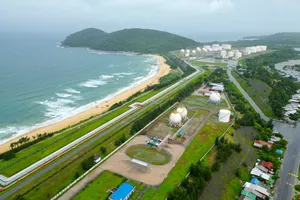
Mr. Dang Xuan Phong also said the Prime Minister instructed relevant agencies to proactively manage domestic gasoline prices in line with global market movements to support production and business activities. He ordered authorities to fully resolve obstacles and ensure adequate ethanol supplies for blending E10 and E5 gasoline without disrupting biofuel production plants, while maintaining the schedule of key energy projects.

At the press conference, responding to a question on the consolidation of villages and residential groups, Deputy Minister of Home Affairs Nguyen Thi Ha said all 34 provinces and centrally governed cities had completed the restructuring in accordance with directives from the Politburo and the Government.
Following the restructuring, the number of villages and residential groups nationwide fell from 89,589 to 48,078, a reduction of more than 46 percent.
She said the restructuring increased the proportion of villages and residential groups meeting official standards, addressed fragmentation, and ensured stability in areas with distinctive historical, cultural, ethnic, religious, defense, security, and geographical characteristics.
According to the deputy minister, local authorities have also reorganized and improved the quality of part-time grassroots personnel by prioritizing individuals with competence, credibility, qualifications, and information technology skills to meet governance requirements in the new period.