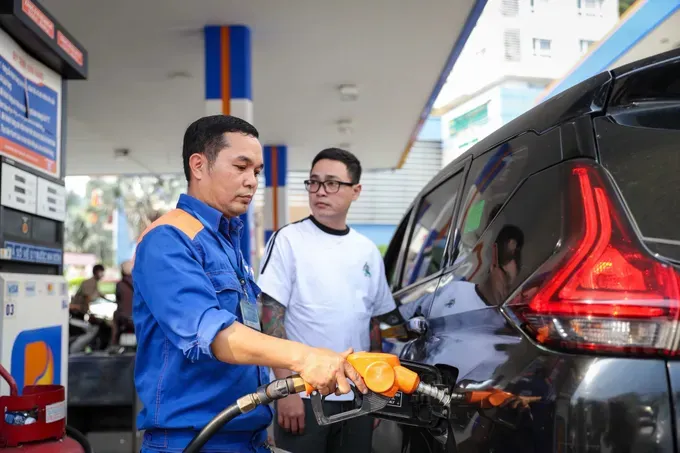
The Government has recently issued Resolution No. 69/NQ-CP regarding the advance disbursement to the Petrol Price Stabilization Fund, sourced from the increase in central budget revenues in 2025.
The decision was made in accordance with the proposal submitted by the Ministry of Finance. The Ministry of Finance shall assume full responsibility for the reported data, as well as the contents and proposals, ensuring strict compliance with prevailing regulations.
The Government has assigned the Ministry of Industry and Trade to take the lead in formulating and deciding on plans for contributions to and expenditures from the Petrol Price Stabilization Fund. These plans will be adjusted in line with varying levels of fuel price volatility, thereby determining appropriate disbursement levels for the fund's utilization.
The Government has agreed in principle to supplement VND8 trillion (US$303 million) to the 2026 state budget expenditure estimates for the Ministry of Industry and Trade. This allocation, sourced from the 2025 central budget revenue surplus, will serve as an advance for the Petrol Price Stabilization Fund, as proposed by the Ministry of Finance. The Prime Minister has been tasked with issuing a decision to formalize this supplementation to the Ministry of Industry and Trade’s 2026 budget estimates.
The Government has assigned specific responsibilities for leading and coordinating the stabilization of petrol and oil prices. Accordingly, the Ministry of Industry and Trade shall take the lead in formulating and deciding on domestic fuel price management scenarios. This includes determining the timing for the use of, and contributions to, the Petrol Price Stabilization Fund, as well as planning for reimbursement to the state budget in accordance with regulations once global fuel prices decline and the domestic market stabilizes. The maximum reimbursement period is set at 12 months from the date the Ministry issues a decision on fund allocation for repayment to the state budget.
In cases where the advanced budget has been fully utilized for fuel price stabilization, while military conflicts in the Middle East continue to escalate and global fuel prices remain on the rise—thereby exerting pressure on inflation control and macroeconomic stability—the Ministry of Industry and Trade shall, within its assigned authority, conduct assessments of the implementation process and promptly propose appropriate solutions. These may include proposals for additional budget advances to the Petrol Price Stabilization Fund (if necessary). Such proposals shall be submitted to the Ministry of Finance for consolidation and reporting to competent authorities for consideration and supplementation of the Ministry’s budget estimates.
The Government has tasked the State Bank of Vietnam and local authorities with implementing coordinated measures to stabilize exchange rates and strengthen oversight of the petroleum distribution system, thereby supporting fuel price stabilization efforts.
The State Bank of Vietnam shall adopt appropriate measures to stabilize exchange rates in support of petrol price stabilization. It is also responsible for directing commercial banks to review, assess, and prioritize credit provision for petroleum enterprises, as well as considering the extension of short-term financing to key fuel distributors to ensure adequate supply in accordance with prevailing laws and regulations.
Provincial and municipal People’s Committees are required to organize the implementation of price stabilization measures promulgated by the central authorities. They shall intensify inspection and supervision of the local petroleum distribution network, ensuring that retail outlets strictly comply with price listing requirements and sell at the listed prices. In addition, local authorities must promptly report developments in supply-demand conditions and fuel prices, while utilizing local budgets, within their capacity, to provide support for disadvantaged areas in line with central government guidelines.
Petroleum wholesalers, distributors, and retailers are required to strictly comply with regulations on circulating reserves and minimum total fuel supply, ensuring the uninterrupted availability of petroleum products to meet public demand even amid price fluctuations.
The Ministry of Finance is tasked with reporting to the Government and the Standing Committee of the National Assembly on the implementation outcomes of the advance allocation to the Petrol Price Stabilization Fund from the 2025 central budget revenue surplus. It shall also report to the National Assembly at its nearest session in accordance with prevailing regulations.
Immediately following the promulgation of Resolution No. 69/NQ-CP, Prime Minister Pham Minh Chinh signed Decision No. 483/QD-TTg, approving an additional VND8 trillion in the 2026 state budget expenditure estimates (categorized under other expenditures) for the Ministry of Industry and Trade. This allocation, sourced from the 2025 central budget revenue surplus, is designated as an advance for the Petrol Price Stabilization Fund, in line with the proposal of the Ministry of Finance.