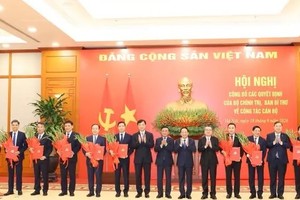
Deputy Prime Minister Le Tien Chau first informed the progress of the current legal document system review, which has been assigned and considered by the Politburo, the Central Steering Committee on Institutional and Legal Improvement, as well as General Secretary cum State President To Lam as an “institutional mass inventory.”
Undeniably the most expansive review campaign to date, it’s the very first time such an effort is being orchestrated to implement the Politburo’s Conclusion No.09-KL/TW, dated March 10, 2026, regarding the refinement of Vietnam’s legal architecture to meet the developmental demands of the nation in the new epoch, ultimately serving to perfect a fundamentally synchronized legal framework.
To meticulously execute the Politburo’s Conclusions and the 2026 work agenda set by the Central Steering Committee on Institutional and Legal Improvement, on April 3, 2026, the National Assembly Standing Committee promulgated Resolution No. 2092/NQ-UBTVQH15 concerning the massive review of the normative legal framework, alongside Resolution No. 2093/NQ-UBTVQH15 to officially establish the Steering Committee for this overarching review, proudly spearheaded by the Chairman of the National Assembly. Subsequently, the Steering Committee officially issued a robust deployment plan to get the ball rolling on this comprehensive review.
The Prime Minister issued Official Dispatch No.32/CD-TTg on April 19, 2026, regarding the organization and execution of this mammoth review. This directive strictly mandates that the final results must explicitly pinpoint every single document, clause, and content requiring action, alongside outlining crystal-clear resolution strategies, be it amending, supplementing, replacing, abolishing, or drafting anew, while firmly designating the leading agencies and their respective completion deadlines.
As of right now, various agencies, organizations, and localities are aggressively tackling this colossal workload in a targeted, substantive manner. They’ve rolled out a comprehensive suite of directives to operationalize the review and are hosting nationwide training conferences to guarantee a unified methodology, while concurrently laying the groundwork for a robust data system to support the overhaul.
They’re also ramping up communication campaigns to drum up widespread interest. To speed up the process, the Ministry of Justice has recently unveiled an upgraded National Legal Database, paired with an Information System tailored to support the sweeping review, marking a profound metamorphosis in cultivating a digital legal ecosystem.
Alongside that, it appears bespoke software designed to assist in inspecting legal documents is actively streamlining data entry via standardized templates. This makes it incredibly easy to aggregate data, track progress in real-time, and ultimately guarantee the unwavering consistency of the comprehensive review’s outcomes nationwide.
Deputy Prime Minister Le Tien Chau also reported the core focus of this critical review, and specific sectors it’ll predominantly target.
“The ultimate goal of this comprehensive review wave is to precisely, thoroughly, and exhaustively evaluate the current state of affairs regarding the normative legal framework across the entire country. From there, we’ll vigorously recommend and propose critical tasks and solutions aimed at forging a highly modern, rational, and scientifically sound legal architecture that meticulously covers every single facet of societal life.”
Deputy Prime Minister Le Tien Chau
This acts as the vital prerequisite for constructing a democratic, streamlined legal system designed to protect human rights, safeguard national security, and drive constructive development. Resting on that foundation, it’ll transform the law into a formidable competitive advantage, satisfying rigorous demands for rapid, sustainable national growth.
The review’s scope is exceptionally broad, reportedly encompassing all legal documents at both central and local tiers currently in effect (except the Constitution), alongside texts issued but not yet effective by October 31, 2026. The audit scrutinizes the labyrinth of decrees and circulars dictating real-world enforcement.
The Steering Committee aims to brief the National Assembly Standing Committee by August 2026, wrapping up the final report and holistic resolution strategies by December 2026.
Embracing that spirit, the Steering Committee has requested local and ministerial heads to treat this review as an urgent political mandate for 2026, taking direct command of final outcomes within their jurisdictions.
Finally, the Deputy Prime Minister mentioned the methods to mobilize ordinary citizens, corporate enterprises, seasoned experts, scientists, and legal eagles to actively jump into the fray, spot glaring loopholes, and pitch their recommendations, given the profound significance of this comprehensive legal review. At the end of the day, this serves as the most relentlessly objective yardstick for measuring the true caliber of national legislation.
The Steering Committee, therefore, explicitly demanded soliciting opinions from citizens, enterprises, impacted demographics, and civil servants regarding bureaucratic headaches or legal bottlenecks. This guarantees an objective, deeply scientific, and receptive review process. It’s impossible to shy away from hard truths and advisable to support amending obsolete provisions, even if they fall under an agency’s own view, ensuring the final results hit the mark with pinpoint accuracy.
Furthermore, the Steering Committee mandated forming specialized, sector-specific task forces to independently appraise and validate review findings from various ministries and localities. A rigorous mechanism for critical counter-arguments and cross-examination is firmly in place. It’s ridiculous to let any agency grade its own homework. Simultaneously, the Vietnam Fatherland Front, the Vietnam Chamber of Commerce and Industry, business communities, and related experts are urged to highlight glaring inadequacies in real-world law enforcement.
Acting as the permanent body, the Ministry of Justice is executing independent appraisals of these reports. They are actively establishing specialized panels featuring experts from the Ministries of Public Security and Home Affairs to lend weight during evaluation.
Dodging superficiality and unfeasible notions
The review trajectory must remain laser-focused on high-stakes fields dictating national development, such as land management, public assets, bidding procedures, decentralization, sci-tech advancement, digital transformation, private sector expansion, and international integration.
Executed with objectivity and scientific accuracy, authorities can’t duck tough calls; they must bravely voice amendments to eliminate complicated, conflicting, or outdated regulations. Concurrently, it’s paramount to aggressively supercharge decentralization while drastically streamlining red tape and business prerequisites, greasing the wheels for citizens and enterprises.
Final audit outcomes must strictly guarantee crystal-clear documentation, explicitly pinpointing specific clauses, bottlenecks, troubleshooting plans, accountable agencies, and hard-and-fast deadlines. Consequently, proposals need to be intensely specific, spelling out exact content to be amended, replaced, or scrapped, successfully dodging vague, superficial, or unfeasible content.