Thanks to several tax policy adjustments, domestic fuel prices have recently dropped sharply compared to early March. However, consumers are frustrated that while fuel prices have fallen, the prices of several essential goods and services remain anchored at high levels.
Commodities are holding steady
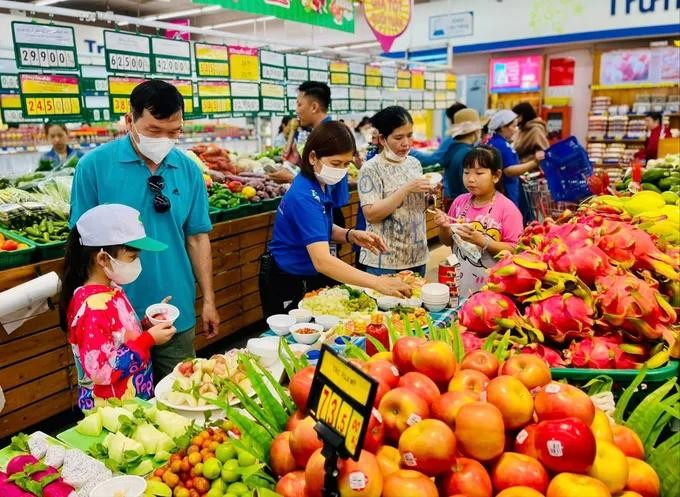
Pointing to a bag of assorted items recently purchased at the market, Ms. Hoang Mai in Trung My Tay Ward, HCMC, noted that food prices have not yet cooled down, especially for processed goods. A plate of broken rice with grilled pork that previously cost VND35,000 has risen to VND40,000, justified by rising fuel costs driving up input prices. Now that fuel prices have decreased, retail prices show no sign of following suit.
She moaned that a few months ago, her family's market expenses were about VND6 million per month, but for the past two months, it has reached approximately VND8 million.
Explaining the reason, Ms. Nguyen Nam, owner of an eatery in Tan Thoi Hiep Ward, HCMC, said that staff wages have increased by VND500,000 per month. Therefore, even if fuel prices return to previous levels, it is difficult to lower the price per meal. Previously, dishes like rice and pho (beef noodle soup), along with coffee, were increased by VND3,000 to VND5,000 at various establishments.
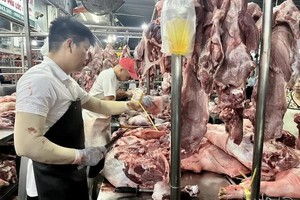
Meanwhile, a comparison between current price lists at the Hoc Mon, Binh Dien, and Thu Duc wholesale markets and those from one month ago reveals a persistent and significant price gap. For instance, red grapes saw the sharpest increase, jumping from VND30,000 per kg to VND55,000 per kg; purple cabbage rose from VND6,000 per kg to VND16,000 per kg; green beans from VND15,000 per kg to VND25,000 per kg; and soursop from VND25,000 per kg to VND35,000 per kg.
Fresh food items also saw hikes; for example, pork ribs rose from VND130,000 per kg to VND140,000 per kg, and pork shoulder from VND110,000 per kg to VND120,000 per kg. Conversely, vegetable prices have dropped significantly: bok choy saw the steepest decline, from VND25,000 per kg to VND5,000 per kg, while leaf lettuce fell from VND40,000 per kg to VND20,000 per kg.
Strict monitoring of price declarations and listings
According to traders, many types of vegetables are currently in peak harvest season, leading to sharp price drops. In contrast, certain fruits and mushrooms are seeing price increases due to limited supply or being out of season. Additionally, the owner of a food supply enterprise in Ho Chi Minh City analyzed that commodity pricing does not depend solely on fuel but also includes seeds, fertilizers, labor, storage costs, and distribution intermediaries.
Furthermore, markets typically experience a price adjustment lag, as many shipments were purchased and transported previously at higher costs; it often takes several inventory cycles for lower costs to be reflected in retail prices.
Nguyen Quang Huy, Deputy Head of the HCMC Market Surveillance Department, stated that market management forces will step up inspections and supervision of legal compliance in business activities, particularly regarding price declarations, listings, and selling at listed prices.
He indicated that the department's staff are concentrating on examining and addressing actions that exploit market fluctuations for purposes of speculation, hoarding, or unjustified price increases, intending to contribute to market stabilization and safeguard consumer rights.
Economic specialist Ngo Tri Long contended that to avert fuel prices from serving as a "license" for successive price increases, it is imperative for authorities to vigilantly oversee sectors that have considerable spillover impacts, including passenger and freight transport, delivery services, retail distribution, wholesale markets, essential commodities, and catering services. In instances where there are indications of unjustifiable price surges, it is essential to carry out inspections, issue warnings, and take prompt corrective actions.