Combined with artificial intelligence (AI), technology is transforming how businesses manufacture products, create offerings, and compete within global supply chains.
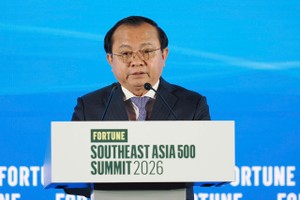
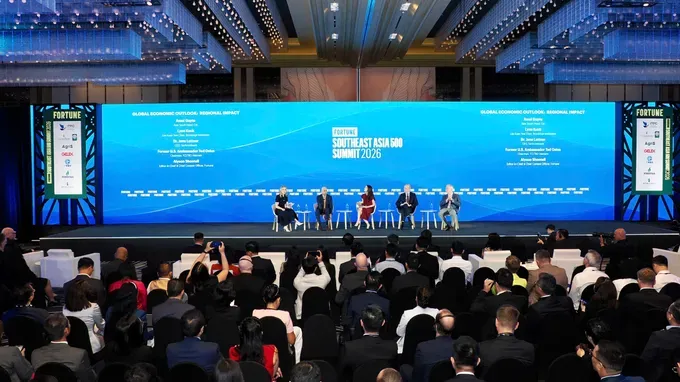
Speaking on November 3 at the 2026 Fortune Southeast Asia 500 Summit in Ho Chi Minh City, industry leaders highlighted the displacement of labor by robots and the role of AI in reshaping corporate competition.
Executives from multinational corporations noted that competitive advantage is shifting away from low labor costs toward the capacity to leverage technology for higher value creation.
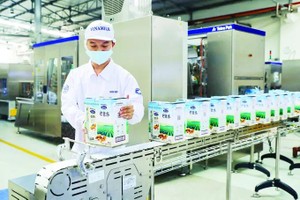
Thammasak Sethaudom, President and CEO of Siam Cement Group (SCG), argued that measuring automation solely by the number of jobs replaced fails to capture its full value. In many cases, robots not only substitute human labor but also perform tasks with higher precision, yielding products that are difficult to achieve through manual methods.
Citing the sanitary ware manufacturing sector, Thammasak noted that manually produced washbasins typically feature thicker walls to compensate for tolerances. By employing robotics, precision is tightly controlled, allowing for thinner, lighter, better-designed products that consume less energy during firing. Consequently, businesses save raw materials, reduce energy costs, and elevate product quality and value.
Drawing from this reality, the SCG leader asserted that automation should not be viewed merely as a cost-cutting tool for workforce reduction. More importantly, technology transforms manufacturing capabilities, enhances quality, and expands competitiveness. SCG is also restructuring its production system by phasing out smaller facilities and concentrating investments in large-scale operations—including projects in Vietnam—to efficiently capture the ASEAN market of roughly 600 to 700 million people.
While robotics reshape production capabilities, AI extends competition into data processing, technology research, and organizational management.
Dr. Jens Lottner, CEO of Techcombank, shared that the bank has provided AI training for 90 percent of its personnel. Rather than confining technology to specialized departments, widespread AI literacy broadens its application across the entire organization.
Amol Gupte, Asia South Cluster & Banking Head for Citi, remarked that the wave of AI investment is generating new growth drivers while simultaneously posing major cybersecurity challenges.
Notably, AI does not only benefit tech conglomerates. Salil Chari, President of Asia Pacific at FedEx, pointed out that Vietnamese enterprises are already manufacturing high-tech fiber optic cables for AI data centers.
Liher Urbizu, President and Managing Director of SAP Southeast Asia, also underscored the role of research and development, noting that SAP’s R&D center in Ho Chi Minh City employs approximately 500 engineers.
According to the speakers, the convergence of AI, cloud computing, and the internet is enabling small and medium-sized enterprises to access tools once restricted to large corporations. However, access to technology does not equate to competitiveness; businesses must still know how to apply technology to production, governance, and product development.
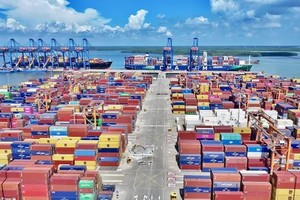
From factory robots to corporate AI governance, competition is shifting from how many staff a company can save to how much value it can generate through technology. For Vietnamese enterprises, the challenge extends beyond investing in machinery or adopting AI—it requires harnessing technology to boost productivity, develop higher-value products, and integrate more deeply into global supply chains.