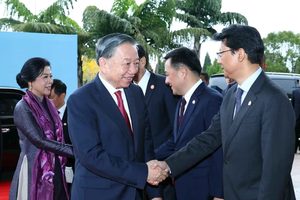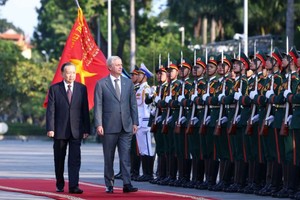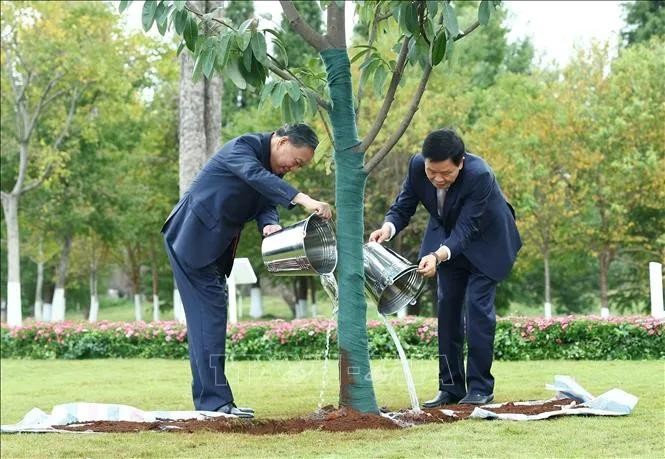
General Secretary of the Communist Party of Vietnam Central Committee and President To Lam planted a commemorative tree at the International Friendship Forest area in Baofeng Wetland Park, beside Dianchi Lake in Kunming, Yunnan province, on November 20.
The activity formed part of his trip to attend the APEC Economic Leaders’ Week 2026 in Shenzhen and conduct bilateral activities in China.
The leader, together with Mo Gaoyi, Secretary of the Communist Party of China Committee of Yunnan province, jointly planted a magnolia tree in the presence of officials from both countries.
The magnolia tree, scientifically known as Michelia maudiae var., is an evergreen woody plant belonging to the Michelia genus of the magnolia family. It is a rare variety of deep-mountain Michelia and one of the world’s uncommon evergreen magnolia species bearing red flowers.
The tree has an upright form, a broad, well-proportioned and elegant canopy, and lush green foliage throughout the year. Its flowers are stately in appearance, with vivid yet delicate colours, elegant pink petals and a long-lasting fragrance.
Built and completed in 2021, Baofeng Wetland Park serves as a site showcasing the long-term achievements of the 15th Conference of the Parties to the UN Convention on Biological Diversity (COP15).
The park covers approximately 108.9 hectares, including around 19.1 hectares dedicated to its main biodiversity exhibition area. The Kunming Dianchi Lake Administration Bureau oversees its technical management, while the Dianchi Lake National Tourism Resort is responsible for its regular management, care and maintenance.
The wetland area follows the principle of “minimising human intervention while maximising ecological benefits”, creating biological communities that closely resemble natural conditions and encompass aquatic, wetland and terrestrial ecosystems. It combines water purification, biodiversity conservation, and public science communication and education.
The park is home to 12 plant communities comprising 101 species. A total of 182 bird species have been recorded in the area, including red-billed gulls, waterhens and swallows. Through artificial breeding and population restoration programmes, the park has also restored rare fish species endemic to Dianchi Lake. It additionally features benthic animals such as freshwater mussels and various snail species.