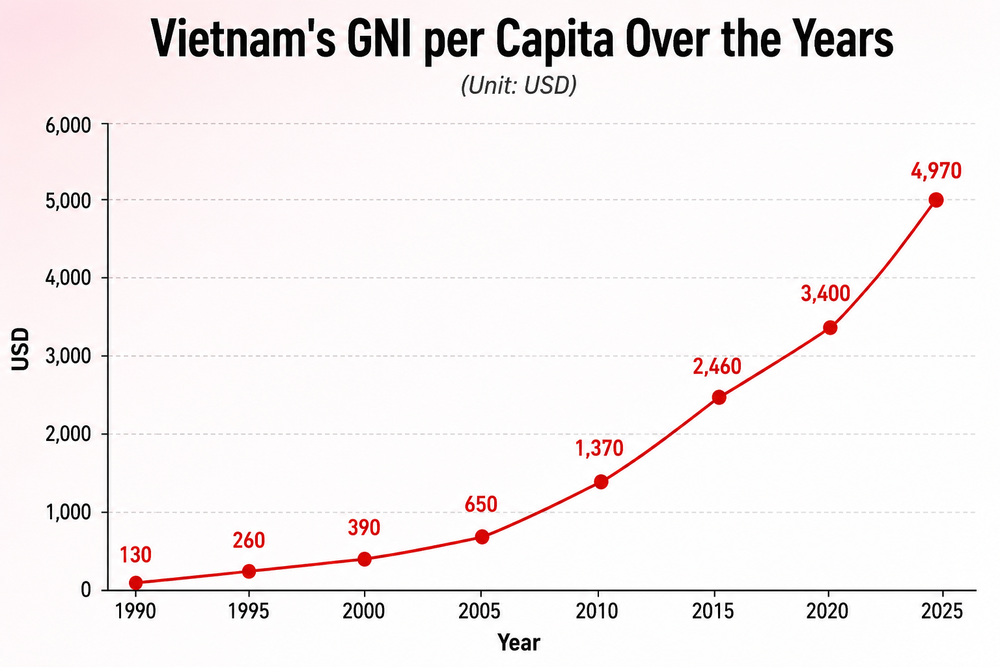
Vietnam has been classified as an upper-middle-income country by the World Bank (WB) after its gross national income (GNI) per capita reached US$4,970 in 2025, marking a significant milestone in the country's economic development.
The new classification reflects Vietnam's steady economic progress over recent years while highlighting the need for a new growth model to sustain development and achieve high-income status, economists said.
Over the 2021-2025 period, Vietnam's GNI increased by an average of about 10 percent annually, demonstrating the economy's resilience and growth momentum.
According to the World Bank, the achievement was driven by two key factors: a strong rebound in exports, which grew by more than 15 percent during 2024-2025, and robust GDP growth of 7 percent and 8 percent in the past two consecutive years.
Le Duy Binh, an economist and chief executive officer of Economica Vietnam, described the upgrade as both recognition of Vietnam's development achievements and a call for stronger reforms to support its long-term ambition of becoming a high-income economy.
He noted that the World Bank classifies economies based on gross national income (GNI) rather than gross domestic product (GDP). While GDP measures the value of goods and services produced within a country's borders, GNI also includes net income earned by citizens and businesses from abroad.
Surpassing the World Bank's upper-middle-income threshold of US$4,636 per capita indicates that Vietnam is moving beyond its role as a manufacturing hub toward generating greater value within global supply chains, he said.
The economist added that it took Vietnam 17 years to move from the lower-middle-income group, which it entered in 2009, to its current classification, reflecting nearly two decades of sustained economic progress.
However, he stressed that the new status should be viewed as a stepping stone rather than a destination. Alongside expanding economic output, Vietnam must strengthen science and technology, innovation capacity, human capital and its position in higher-value segments of global supply chains.

The country also faces increasingly complex development challenges, including the risk of falling into the middle-income trap, population aging, rising social welfare demands, widening income inequality and growing pressure on energy and natural resources.
To ensure sustainable growth, Vietnam will need to accelerate its transition to a green economy by improving resource efficiency and reducing greenhouse gas emissions, Binh said.
Nguyen Thi Mai Hanh, Head of the National Accounts Department under the Statistics Office of the Ministry of Finance, said that the World Bank's classification reflects a change in economic categorization rather than an indication that Vietnam has become a developed country or significantly narrowed its income gap with advanced economies.
She said that productivity, innovation and economic competitiveness remain key priorities. More importantly, the new classification should translate into tangible improvements in people's incomes and living standards rather than remain a statistical milestone.
According to the Statistics Office, the average monthly income of Vietnamese workers reached nearly VND9 million (about US$345) in the second quarter of 2026, down slightly by VND53,000 (US$2) from the previous quarter. Meanwhile, more than 96 percent of surveyed households reported that their income was stable or had increased compared with the same period last year.
Economists also said the upgrade is expected to strengthen Vietnam's international standing, giving the country greater influence in economic negotiations and enhancing its bargaining position in next-generation free trade agreements.