However, the initiative has hit critical bottlenecks, including severe staffing shortages, data integration hurdles, and low public participation. Municipal health authorities are now moving aggressively to clear these obstacles and accelerate progress, aiming to bring every resident under managed care.
Speaking with Sai Gon Giai Phong Newspaper, Assoc. Prof. Dr. Tang Chi Thuong, Director of the Ho Chi Minh City Department of Health, emphasized that the universal health check-ups lays the groundwork for a strategic shift in the healthcare system, pivoting from reactive disease treatment to proactive, comprehensive, and sustainable care.
A multi-pronged approach

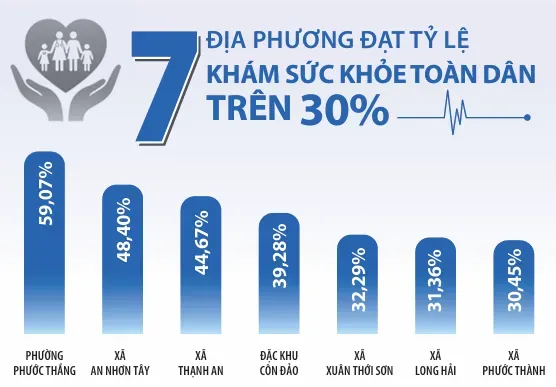
According to Ho Chi Minh City Department of Health Director Tang Chi Thuong, implementation progress varies starkly across the city. While some wards have screened nearly 50 percent of their local population, others hover below 5 percent. This early-stage disparity was entirely predictable, attributed to stark differences in demographic scale, residential stability, socioeconomic conditions, and local execution strategies.
Localities leading the drive share key success factors, such as decisive leadership from local authorities, seamless coordination between health centers, regional hospitals, and community groups, and flexible screening formats, including after-hours sessions, mobile clinics, and home visits for the elderly and mobility-impaired. Conversely, slower-performing areas face headwinds such as dense and highly transient populations, shift-based workforces, and low public awareness regarding routine health check-ups.
"Our priority is not a citywide ranking," the health chief emphasized, clarifying that the city's digital management dashboard was built to spot bottlenecks and deploy targeted assistance rather than pit areas against one another. The ultimate goal remains universal access: ensuring every resident receives care, and no one is left behind.

The single biggest hurdle remains public perception: persuading residents to recognize the value of routine check-ups and voluntarily participate. In practice, many still bypass screenings, assuming they are in good health; others are tied up with work or have been tested elsewhere without their records being digitized. Meanwhile, elderly residents and people with disabilities face physical mobility constraints.
Reaching 100 percent universal health coverage by 2026 is a formidable challenge, yet entirely achievable provided there is sustained, synchronized backing across the entire political system. To this end, Ho Chi Minh City’s health sector is rolling out a multi-pronged offensive: permitting cross-locality health screenings, deploying additional mobile medical units, and leveraging continuous care teams to deliver home-based check-ups for senior citizens and individuals with disabilities.
Should residents notice discrepancies in their electronic health records, they can flag errors via the Ho Chi Minh City Digital Citizen app or directly at the attending healthcare facility. Following clinical verification, medical staff will update and adjust the records in accordance with regulatory standards.
Strictly safeguarded health data

Electronic health records serve as a personal "health diary" for every citizen. The system aggregates personal identifiers, medical histories, risk factors, routine check-up results, outpatient visits, clinical diagnoses, lab tests, medical imaging, prescriptions, immunizations, and chronic disease management metrics—continuously updated over a lifetime of care. Crucially, these profiles are far more than static snapshots from a single visit.
Every medical interaction adds a new "data footprint," giving physicians a comprehensive view of patient health while ensuring safer, seamless continuity of care. Under the city's roadmap, Electronic Health Records will fully integrate with electronic medical records by late 2026. This landmark integration will transform standard health profiles into a dynamic "medical history log" for every resident.
Health data is classified as highly sensitive personal information and must be safeguarded to the highest standards. To this end, city authorities are deploying a multi-layered security framework, encompassing robust IT infrastructure, data encryption, role-based access controls, user authentication, and end-to-end access logging.
The Department of Health’s stance is unequivocal: access is granted strictly on a need-to-know basis tied directly to professional duties. Every single query must be audited and accountable. Digital transformation can only succeed on a foundation of public trust. Safeguarding citizens' health data is not merely a technical or legal mandate; it is a moral imperative and a fundamental duty for every healthcare professional, Department of Health Director Tang Chi Thuong said
The year 2026 marks the dawn of a deeply strategic era. Ho Chi Minh City’s ultimate objective extends far beyond completing a single citywide screening drive; it aims to build a continuous care ecosystem where every resident possesses a lifelong electronic health record. Each medical encounter enriches this data pool to sharpen clinical outcomes, while every policy decision is grounded in solid scientific evidence.
Moving forward, routine health check-ups will be progressively integrated into daily life through a robust network of ward health stations, family doctors, regional hospitals, and community-based Continuous Care Teams. As data accumulates over time, Ho Chi Minh City will not only effectively manage individual health but also forecast disease trends, proactively curb epidemics, optimize resource allocation, and craft increasingly pragmatic, evidence-based health policies.
According to Assoc. Prof. Dr. Nguyen Anh Dung, Deputy Director of the Ho Chi Minh City Department of Health, the city’s healthcare sector is mobilizing its entire network to ensure speed, quality, clinical excellence, and equitable access for all residents. To date, over 480 healthcare facilities, spanning public, private, and ministry-level hospitals, ward health centers, and polyclinics, alongside more than 10,000 fully trained medical personnel, are primed for deployment.
A defining feature of this citywide drive is the active involvement of the private healthcare sector. In a prominent recent development, City International Hospital and Gia An 115 Hospital signed agreements with the People’s Committees of Phu Lam and An Lac wards to deliver health screenings for residents.
The two hospitals will deploy top-tier specialists, state-of-the-art medical equipment, and internationally certified quality control protocols to ensure clinical precision and give citizens access to high-tech medical technology. In a similar partnership, Hong Duc III Hospital has teamed up with Dong Hung Thuan Ward to conduct routine check-ups for the local community.