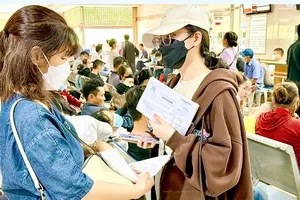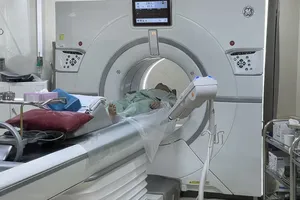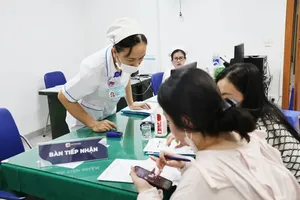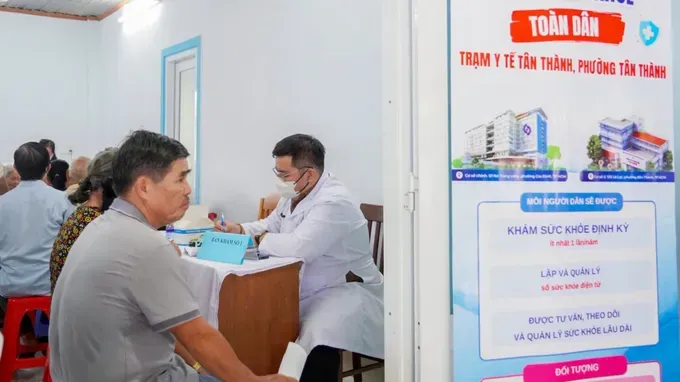
According to the Ho Chi Minh City Department of Health on July 27, medical facilities across the city conducted 263,327 health checks over the past week, July 20–26. This brought the total number of screened residents to 1,073,948.
Several wards and communes maintained a remarkably high pace. Phuoc Thang Ward led the city with 10,921 check-ups, followed closely by Long Hai Commune with 10,871, Ba Diem Commune with 7,240, Tan My Ward with 7,238, and Tang Nhon Phu Ward with 7,145.
To date, six localities have covered at least 25 percent of their population, including Phuoc Thang Ward with 48.8 percent, Thanh An Commune with 43.4 percent, An Nhon Tay Commune with 37.7 percent, Con Dao Special Zone with 37 percent, Phu Hoa Dong Commune with 26.2 percent, and Xuan Thoi Son Commune with 25 percent.
Despite the rapid acceleration in many areas, the data highlights stark regional disparities across the city. Over the past week, five wards, communes, and special zones recorded fewer than 200 health checks, including Con Dao Special Zone with 44 checks, Thanh An Commune with 58, Hoa Loi Ward with 146, Phu Tho Ward with 181, and Ben Thanh Ward with 184.
Most notably, in terms of coverage rates, four localities have screened under 3 percent of their population: Ben Thanh Ward with 2.1 percent, Tan Hiep Ward with 2.5 percent, Tan Uyen Ward with 2.6 percent, and Cau Ong Lanh Ward with 2.9 percent.
According to Assoc. Prof. Dr. Tang Chi Thuong, Director of the Ho Chi Minh City Department of Health, as the city enters a high-intensity emulation campaign, lagging localities must urgently investigate the underlying causes and establish detailed weekly and daily plans. He emphasized the need to step up public communications, offer after-hours screenings, and conduct mobile and home visits for the elderly and people with disabilities, alongside catch-up screening drives to swiftly narrow the gap with leading areas.
The Department of Health requested People's Committees of wards, communes, and special zones to maintain their coordinating role and directly monitor local implementation. Local authorities are also urged to strengthen coordination with hospitals, health centers, and medical facilities to provide continuous, flexible screenings tailored to residents' needs.
Alongside scaling up screening numbers, local authorities and healthcare providers must designate focal points responsible for fully, accurately, and promptly updating results to the Community Health Management Platform. This ensures data integration into electronic health records, allowing every resident to maintain a comprehensive health profile for continuous, lifelong healthcare management.