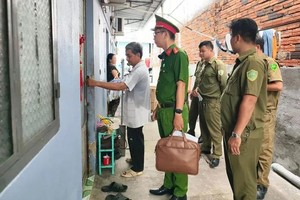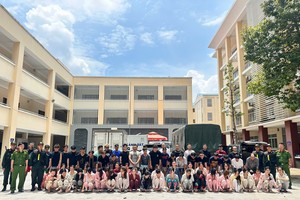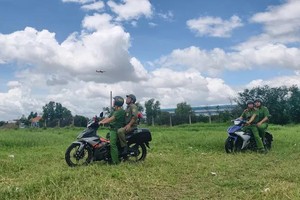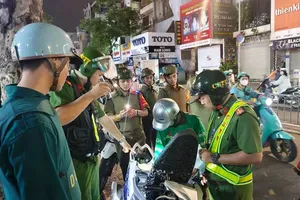
On the evening of August 13, an airborne object was spotted near Tham Luong Bridge, prompting several flights at Tan Son Nhat International Airport to temporarily suspend takeoffs. Binh Hung Hoa Ward police tracked down and documented a group of people flying kites on an open plot of land.
On August 14, a representative of the Binh Hung Hoa Ward People’s Committee said local police were compiling case files to take action against people flying kites near the takeoff and landing areas of Tan Son Nhat International Airport.
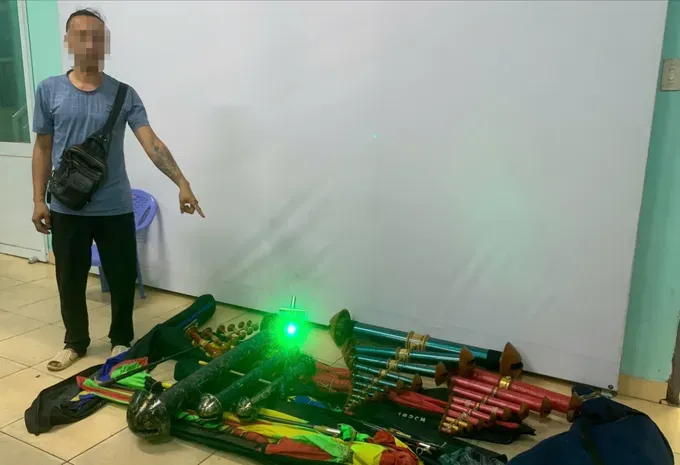
Earlier, on the evening of August 13, authorities detected an airborne object moving from the direction of Tham Luong Bridge towards the western side of the airport. To ensure flight safety, several aircraft were instructed to temporarily suspend takeoffs. Authorities promptly searched the area and found a group of people flying kites on an open plot of land in Binh Hung Hoa Ward.
Binh Hung Hoa Ward police confiscated the kites and summoned the individuals involved to the police station for questioning. A ward police representative said authorities were finalizing the case files to strictly handle the violations in accordance with regulations.
Earlier, Sai Gon Giai Phong Newspaper reported on kite-flying activities at an open plot of land near the Tham Luong Canal in Dong Hung Thuan Ward. Numerous kites, some measuring more than 2 meters across and equipped with whistles and flashing lights, have been flown day and night on strings hundreds of meters long.
The activity not only poses a potential threat to flight safety but also causes serious disruption to nearby residential areas due to the noise from the kite whistles, particularly at night. Dong Hung Thuan Ward police subsequently worked with those involved and requested that they stop flying kites at night in the area.
Also in connection with the incident, a representative of the Vietnam Air Traffic Management Corporation (VATM) told Sai Gon Giai Phong reporters at noon on August 14 that at around 7:40 p.m. on August 13, air traffic control units received information about an airborne object spotted in the direction of Tham Luong.
At 8:02 p.m., the airborne object was identified in Tay Thanh Ward. Amid concerns that it could affect flight operations, the Southern Airports Authority requested that takeoffs and landings at Tan Son Nhat International Airport be temporarily suspended to verify the situation.
Flight operations resumed at 8:16 p.m. During the suspension, 21 flights were affected.
At 8:34 p.m., authorities confirmed that the airborne objects were three kites fitted with lights. Local police recorded the incident and took action in accordance with regulations.
According to VATM, Tan Son Nhat International Airport has a high traffic volume and is located in a densely populated urban area. Therefore, public awareness plays an important role in ensuring aviation safety.
VATM recommended that kites, drones, camera drones and other airborne objects be used strictly in accordance with regulations and that they must never be operated in areas where they could pose a threat to flight safety.
Ensuring flight safety is the highest priority and a shared responsibility of the entire society, VATM said.
According to lawyer Le Van Hoan of the Ho Chi Minh City Bar Association, flying kites into the airspace around an airport threatens aviation safety and security and violates regulations on national defense, security and flight safety, as well as public order, safety and interests.
Under Clause 11, Article 8 of Decree No. 282/2025, operators of ultralight aircraft that obstruct or endanger other aircraft may be fined VND30-40 million (US$1,148 – US$1,532). If such conduct causes damage of VND100 million (US$3,830) or more, the operator may also face criminal prosecution for the offense of “Obstructing Air Traffic” and be required to fully compensate for all actual losses incurred.
Lawyer Le Van Hoan noted that enforcement could face difficulties, including identifying individuals flying kites within aircraft takeoff and landing areas. In addition, accurately assessing and valuing the total damage as a basis for handling the case could be time-consuming and require coordination among multiple agencies, including airport authorities, airlines and the VATM.