Scores of modern, well-equipped schools have been completed in border areas just before the new school year under a Politburo policy, bringing joy to tens of thousands of students and parents while helping turn aspirations for a better life into reality through education.
Border-area boarding schools open doors to new school year
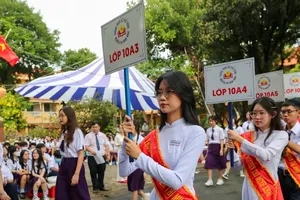
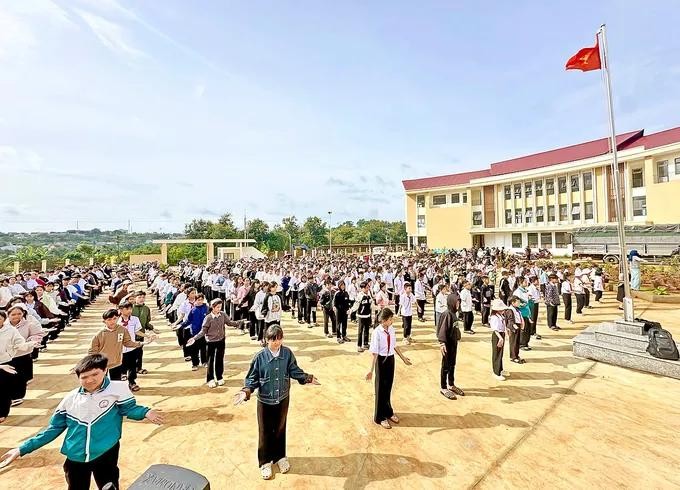
Early on Sept. 3, the road leading to Thuan An Commune multi-level Primary and Lower Secondary Boarding School in Lam Dong Province was bustling with students and parents. Laughter and excited looks from children on their first day of class brought the new school to life ahead of the 2026-2027 school year. On the spacious campus, groups of students chatted as they searched for their classrooms with guidance from teachers. Elsewhere, music filled the air as students rehearsed graceful dance routines for the opening ceremony.
The joy was evident on the face of Vo Thi Thu Van, a resident of Thuan An Commune. Standing on the spacious campus, surrounded by modern classrooms, dormitories and living facilities, she said: “Investment by the Party and State has given children in border areas a learning environment that many families had never dared to dream of. It is not just a school but also a source of support that allows us to work with peace of mind and stabilize our lives.”
Wearing the traditional attire of the M’Nong ethnic group, second-grader K’Y Quoc Tuong could not hide his excitement about getting to use the spacious soccer field and swimming pool after school. This school year, many parents also have significantly less to worry about as their children receive textbooks, school supplies and uniforms, as well as accommodation, meals and other living conditions at the school.
These days, teachers at A Vuong Commune multi-level Primary and Lower Secondary Boarding School in A Vuong Commune, Da Nang City, have been busy arranging classrooms, completing dormitories, preparing the cafeteria and getting other facilities ready to welcome students. New classroom blocks, dormitories, a multipurpose building and other facilities are gradually taking shape.
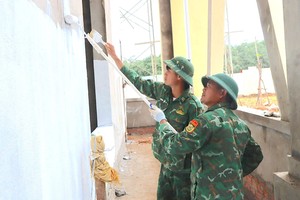
Heading back to the Central Highlands, five multi-level ethnic minority boarding schools in border communes of Dak Lak Province , including Ia Lop, Ia Rve, Buon Don, Ea Rok and Ea Bung, are also taking shape. Under the intense border-area sun, soldiers from Military Construction Corporation 789 under the Ministry of National Defense were working urgently at multi-level Primary and Lower Secondary Boarding School in Ea Rok Commune to clean and arrange equipment in completed administrative and classroom buildings, ensuring they could be handed over to local authorities in time for the opening of the new school year.
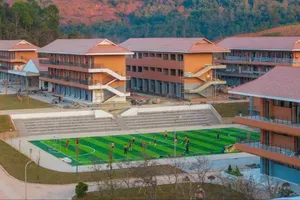
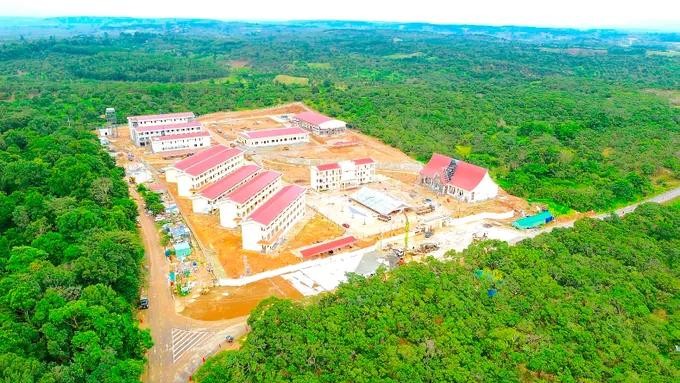
In Ia Puch Commune, Gia Lai Province, multi-level Primary and Lower Secondary Boarding School is 99 percent complete. Surrounded by vast green forests, the new school, with its spacious buildings and distinctive colors, has given the border area a new look.
This is a major initiative with long-term significance for the education and well-being of students in border and disadvantaged areas. Local authorities must pay special attention to the management and operation of these facilities once completed covering everything from student enrollment, teacher allocation, and student care arrangements to encouraging local residents to send their children to school. In the 2026–2027 academic year, the Ministry of Education and Training will effectively implement the border boarding school model, evaluate its impact, and expand it to other disadvantaged areas.
Minister of Education and Training Hoang Minh Son
Border provinces accelerate modern school infrastructure development
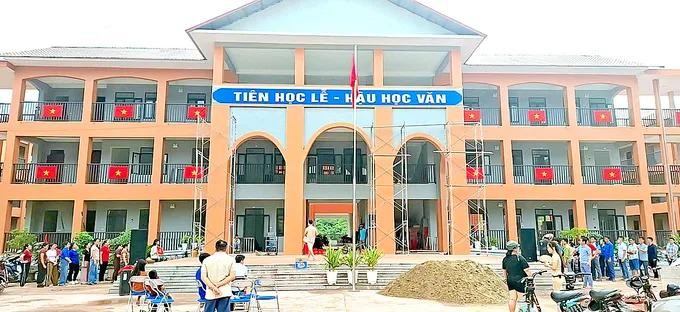
Teachers and students at multi-level Primary and Lower Secondary Boarding School in Dien Bien Province’s Sin Thau Commune were also eagerly rehearsing for the new school year’s opening ceremony at the newly completed school, although some facilities remained unfinished. School Principal Le Bao Khuong said the project is about 91-92 percent complete. The classroom building and one student dormitory have been put into use in time for the new school year, while several other facilities will continue to be completed after Sept. 5.
In Dien Bien Province, all border boarding schools have completed enrollment. Chairman Le Van Luong of the Dien Bien Provincial People’s Committee said the province will inaugurate and put nine multi-level boarding schools into operation on Sept. 5. Earlier, multi-level Primary and Lower Secondary Boarding School in Si Pa Phin Commune was completed and put into use on Jan. 31, 2026, becoming the first project completed under the Politburo’s policy of building multi-level boarding schools in mainland border communes.
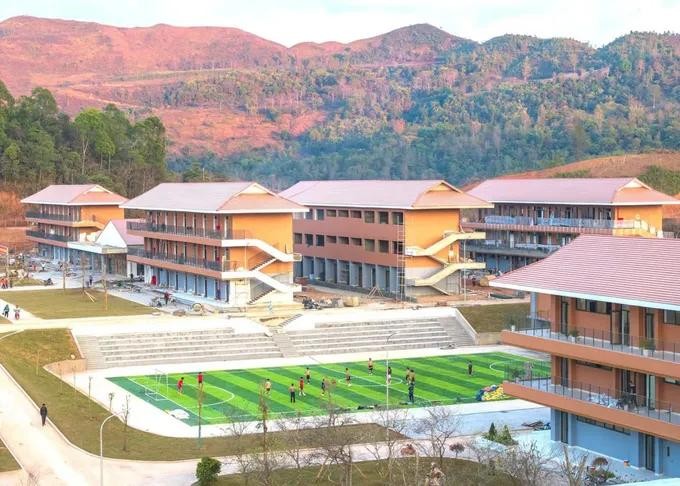
School’ Vice Principal Bui Thi Luong said that before the new school was built, students had to stay at the school under very cramped conditions, with 15-20 students sharing a room. Winters were cold and summers hot. Now, she said, the students are very happy to study and live in solid, spacious and modern rooms.
This year, many students in border areas of An Giang Province are also attending a new, spacious school with full facilities. According to the An Giang Department of Education and Training, in the 2026-2027 school year, three multi-level boarding schools in the province’s border areas, comprising Giang Thanh Primary and Lower Secondary School in Giang Thanh Commune, Vinh Gia Primary and Lower Secondary School in Vinh Gia Commune, and Khanh An Primary and Lower Secondary School in Khanh Binh Commune, have been put into operation, serving more than 3,770 students.
Village elder Ro Lan Hlek of Klah Village in Ia Mo Commune, Gia Lai Province, noted that Klah Village comprises 186 households facing economic hardship. Many children in the village lack consistent school attendance, requiring village officials and him to frequently visit individual homes to encourage enrollment. Parents are often busy working in the fields, leaving them with neither the time to transport their children to school nor the means to supervise their studies.
Now, these challenges are being addressed through the province's construction of a new boarding school designed for over 1,200 students, scheduled to open for the 2026–2027 academic year. I believe that the presence of this boarding school will transform Klah Village and provide our children with the opportunity to become independent and mature.
Ksor My Phuoc, a second-year student at Ho Chi Minh City University of Education, shared that having been born and raised in Gia Lai, she deeply understands the hardships faced by students in remote, isolated, and border regions. Over the years, thanks to the attention of the Party and the State, ethnic minority students have benefited from numerous support policies—policies from which she herself was fortunate enough to benefit.
In border areas, local residents face significant hardships; students lack adequate resources for learning and transportation, struggle to acquire knowledge, and are at high risk of dropping out of school. The construction of numerous boarding schools in border areas will provide ethnic minority students with the opportunity to attend school, opening the door to the future through the light of knowledge. She personally hopes to have the chance to volunteer as a teacher at these border boarding schools in the future.