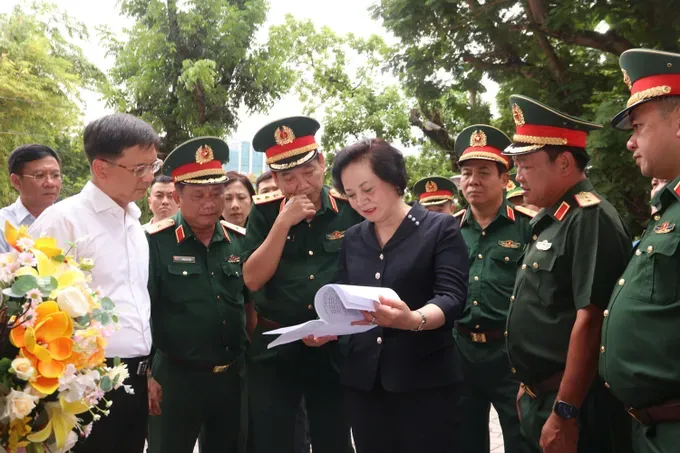
For one elderly witness, the memories remained remarkably vivid as he bent down, quietly observing the ground before turning to the HCMC Command officers standing nearby. “Right here... that day the trucks brought the soldiers in,” he slowly explained. Nobody uttered another word. An officer swiftly marked the coordinates.
The gathering team just stood there in silence, keenly observing. Nearly 60 years after the liberation fighters bravely fell during the 1968 Mau Than Spring Offensive, the ingrained memory of an old witness miraculously transformed into a highly special coordinate to track down lost comrades.
Few folks actually realize that today’s robust search deployment at Le Thi Rieng Park is the direct culmination of countless months of meticulous preparation. This featured dozens of encounters with witnesses, thousands of carefully cross-referenced document pages, and multiple survey phases utilizing cutting-edge scientific methods.
Throughout that extraordinary journey, the HCMC Command has consistently stood out as the core force, intensely running the complex process of surveying, verifying, searching for, and gathering the martyrs’ remains.
Nguyen Xuan Thang, a member of the Deputy Prime Minister’s advisory team, helped provide crucial historical documents concerning the Chi Hoa – Cho Quan cemetery, which is now Le Thi Rieng Park. By thoroughly studying historical photos, satellite imagery, and archival documents, they initially determined that on February 12, 1968, the former administration orchestrated a mass burial of numerous liberation fighters who bravely perished during the Mau Than Spring General Offensive and Uprising.
Several signs inherently indicate that at least three massive mass grave trenches were systematically formed during that specific period. However, after nearly six decades, it appears the area’s topography has almost completely transformed. Pinpointing the exact locations of these grave trenches morphed into an incredibly challenging task, demanding sheer perseverance and a highly scientific approach.
Having said that, the HCMC Command still explicitly determined that to find the right spots. Based on its proposal, the Steering Committee for Searching, Gathering, and Identifying Martyrs’ Remains of HCMC (HCMC Steering Committee 515) had to start with the people, proactively coordinating with press agencies to track down key witnesses.
On May 31, 2026, the very first survey delegation officially arrived at the sprawling park. The witnesses directly led the delegation through every single area, rigorously cross-referencing topographical landmarks. What they pointed out remarkably coincided with comprehensive research results derived from military maps and satellite imagery. Only when multiple information sources seamlessly aligned was the data officially brought into the survey scope.
Among those accompanying the search forces, the story of Vo Huy Dinh has left behind an abundance of profound emotions. Already 75 years old, he earns his living selling lottery tickets right in HCMC. When invited to assist with field verification, he agreed without breaking a sweat, readily accepting the loss of his meager income just to accompany the survey delegation.
Under the fiercely scorching sun, the silver-haired man slowly guided the officers. He stood dead silent for several minutes just to trigger the recollection of a single detail. Nobody rushed him, because at the end of the day, every awakened memory could unlock a fresh ray of hope in finding their lost comrades.
Much like Mr. Dinh, Nguyen Thanh Phuoc was consistently present whenever search forces desperately needed supplementary information. For Mr. Phuoc, despite being swamped with his daily livelihood struggles, the mission took priority.
“Whenever I received a call, I instantly set my personal matters aside and headed straight to the scene,” he recounted. Merely one week after the information was widely disseminated, the witnesses who directly saw the 1968 mass burial were successfully tracked down, undeniably serving as a massive turning point, boldly opening up a brand-new approach for the search.
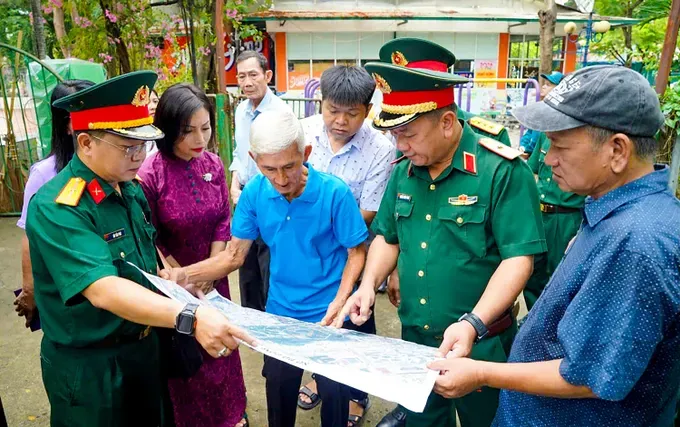
Running parallel with the meticulous collection of witness testimonies, the HCMC Command proactively advised the HCMC Steering Committee 515 to mobilize top-tier scientific units. They collaboratively deployed ground-penetrating radar and cutting-edge geophysical methods. After four days of independent surveying, all units successfully pinpointed two distinct areas exhibiting abnormal underground signals to kick off exploratory digging.
It appears this practical approach, flawlessly combining historical documents with highly advanced technical equipment, tremendously helped narrow down the search scope and strictly minimize unnecessary impacts on the scene.
On June 23, 2026, the first pickaxe strikes were officially executed right at point A. The scene essentially fell completely silent as every layer of dirt was meticulously peeled back under intense supervision. By the second day, the grim structure of a mass burial trench gradually emerged, followed by fragments of military hammocks and the very first sets of human remains.
There weren’t any cheers of joy. The HCMC Command soldiers just stood quietly at strict attention. Countless officers couldn’t hold back their tears because, after nearly 60 agonizing years, their comrades had finally been tracked down.
Initial results successfully identified a grave trench measuring roughly 25 meters long, uncovering five sets of remains alongside numerous bone fragments. This is highly presumed to be one of three mass grave trenches visibly appearing in 1968 historical photographs. This profound discovery firmly affirms the search trajectory.
Immediately thereafter, the HCMC Command advised military leaders to comprehensively prepare all necessary conditions for the gathering phase. Establishing a temporary command post, arranging a designated DNA sampling area, and forming specialized groups were all meticulously prepared. The paramount objective is to flawlessly ensure the process unfolds according to protocol, remaining extremely solemn and absolutely safe.
The deafening gunfire of war is long gone, yet the core qualities of the soldiers remain completely intact. These thorough search operations right at Le Thi Rieng Park are persistently underway. A series of hardships still lies dead ahead since the local topography has drastically altered.
However, the unwavering faith in bringing the fallen heroes back home is organically strengthening. Right in the bustling heart of the city, peeling back every square meter of dirt isn’t merely an excavation; it vividly affirms that the Vietnamese nation will absolutely never forget those who fiercely dedicated their youth to independence.
Every excavated meter is approached with extreme caution, and every poignant artifact is delicately cherished. Every fresh piece of information is accurately jotted down and strictly cross-referenced. Amidst today’s dynamic urban life, these soldiers are still quietly continuing their tasks, driven entirely by political consciousness and an immensely sacred affection for the comrades who bravely fell.









)