Cadre capability as cornerstone
Looking back at recent robust reforms in organization, training, discipline, and responsibility, a common lesson emerges. For the country to develop rapidly and sustainably, there must be a cadre corps that thinks big, acts effectively, and dares to take responsibility.
Former Deputy Minister of Internal Affairs Nguyen Tien Dinh notes that with citizen satisfaction as the primary metric, the state must shift from management to people-centric governance. He argues that traditional administrative skills are now insufficient. Modern cadres must transcend simple paperwork to master technology, data analysis, and innovative thinking. This evolution is essential to navigate the transparency, data reliance, and rapid interactions of a modern digital society effectively.
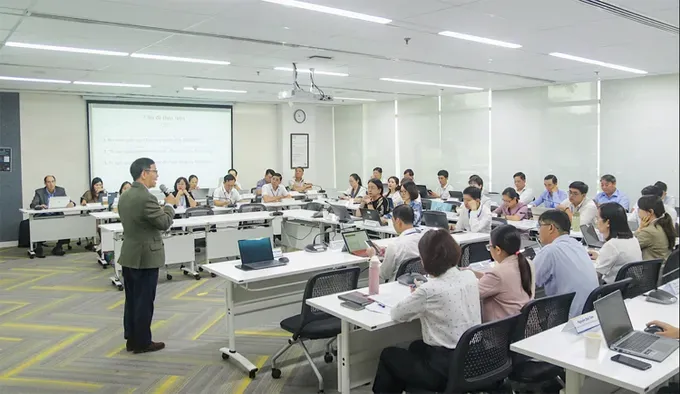
Grassroots reality shows this requirement is gradually entering daily life. In Tan Hung Ward of HCMC, equipping cadres with digital skills has been implemented methodically. The ward coordinated with the University of Economics HCMC to train all officials and civil servants in AI.
From the course, the ward’s cadre team directly built a virtual assistant model of Q&A for administrative procedures. This tool has served tens of thousands of inquiries, significantly reducing the direct response load for civil servants and helping residents proactively access information. “The cost is low, and the effectiveness is very clear,” assessed Chairman Nguyen Duc Tri of the Tan Hung Ward People’s Committee.
HCMC is also one of the localities pioneering wide-scale AI training for cadres from grassroots to city levels. On a national scale, the Ministry of Science and Technology organized an online training course connecting 34 localities, equipping the commune-level teams, the force working most directly with the people, with knowledge on innovation and digital transformation.
These efforts concretize the message in the draft documents for the 14th Party Congress: “Building a cadre corps adaptable to the digital transformation era, capable of forecasting, creativity, and social connection.”
For the 14th Congress, President Nguyen Thi Thu Ha of Binh Duong University of Economics and Technology emphasizes that cadres need both professional capacity and prestige. They must remain “close to the people” to propose effective policies. Additionally, strict supervision and periodic rotation for sensitive positions are essential to limit power abuse and safeguard public trust.
Mechanisms paving way for creative cadres
If capacity requirements are the core for the cadre corps, then on a broader plane, according to Dr Nguyen Thi Viet Ha of Saigon University, policies and mechanisms are creating breakthroughs in personnel work, serving as one of the most important pillars in the preparation process for the 14th Party Congress.
Regulation No. 377-QD/TW decentralizes personnel work, eliminating the “lifetime safety” mindset by enabling the removal of unsuitable staff. Complemented by output-based evaluations under Regulations 89-QD/TW and 132-QD/TW, the system now prioritizes merit over seniority. Notably, new institutional protections for cadres who “dare to think and do” actively encourage dynamic, responsible leadership.
From a public governance perspective, Prof Dr Nguyen Quoc Suu of the National Academy of Public Administration, believes modernizing administration cannot stop at appointment or discipline regulations. It must advance towards a civil service system based on merit, transparency, self-regulation through social supervision, and clear accountability.
He analyzed that Government Decree No.90/2020/ND-CP on evaluating quality of cadres and civil servants has shifted the focus from qualitative to quantitative, making output results the core criterion. Accordingly, Quang Ninh Province, Long An Province (now part of Tay Ninh Province), and HCMC have established mechanisms to assign work by product, classifying civil servants based on specific output criteria and linking results to rewards or position adjustments.
The spirit of training by job position is also concretized via Government Decree No.171/2025/ND-CP regulating civil servant training. Many localities have deployed training by title, ensuring each position is equipped with the right necessary skills rather than spread-out training.
According to Dr Nguyen Thi Viet Ha’s analysis, the Party’s expectation for personnel work goes beyond fostering a professional team; it aims to build a human foundation as the decisive resource for national strength. When cadres have vision, leadership ability, and political mettle, institutions will see robust reforms and flexible operation; and when the team knows how to innovate, the nation will be capable of breakthroughs, stepping into a new development phase.
Former Vice President of the Vietnam Fatherland Front Central Committee To Thi Bich Chau comments that the 14th Party Congress draft documents place people, particularly cadres, at the center of national development. This vision is crucial for a powerful Vietnam by 2045, demanding leaders of integrity who dare to take responsibility.
The system is shifting from a “sufficient people” to a “right people” mindset, streamlining management to reduce intermediaries. Consequently, strategic cadres require national vision, while grassroots staff must embody a spirit of service. Ultimately, leaders must demonstrate integrity, serving as the bridge between the Party’s will and the people.
National Assembly Delegate Truong Trong Nghia from HCMC emphasizes that rapidly shifting to a new growth model is vital for Vietnam to join developed nations. However, he identifies the “human factor” as the decisive challenge determining success.
He points out that current decentralization is hamstrung by insufficient financial, technological, and human resources, creating significant psychological pressure on officials. Therefore, he urges that appointing leadership cadres must rely entirely on scientific, objective, and impartial standards. Prioritizing these rigorous criteria is essential to ensure the success of national guidelines and serve the country’s highest benefit.



)