The Ministry of Foreign Affairs has repeatedly rejected “biased and inaccurate” evaluations in various reports. Nevertheless, most recently on March 4, the USCIRF (United States Commission on International Religious Freedom) continued to release its 2025 annual report, which contains speculative and accusatory content regarding the religious situation in Vietnam.
According to Dr Hoang Van Chung from the Institute of Anthropology and Religious Studies (the Vietnam Academy of Social Sciences), this is a clear manifestation of “politicizing” religious matters. It’s particularly evident when isolated incidents or even outright criminal acts are stripped of their specific context and inflated into claims of systemic “religious persecution.” This approach lacks a factual basis and intentionally blurs the line between state management and religious interference.
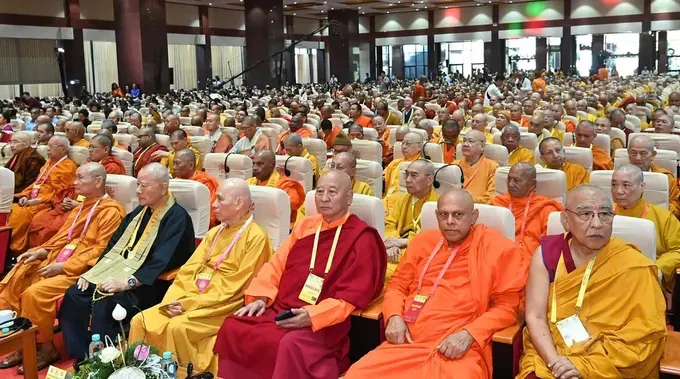
Vietnam is a multi-religious nation with over 28 million followers and tens of thousands of worship facilities. The right to freedom of belief is enshrined in the 2013 Constitution and codified by the 2016 Law on Belief and Religion, a piece of legislation regarded as comprehensive and aligned with international norms. In practice, religious activities occur openly and stably, ranging from daily worship to major festivals that attract vast numbers of participants.
However, there’ve been recent instances where individuals exploited religious labels for malicious ends. A prime example occurred in October 2025, when the Dak Lak Province Public Security Department initiated legal proceedings against 58-year-old Y Nuen Ayŭn from Ea Phe Commune for sabotaging solidarity policies.
Initial investigations revealed that since 2019, he joined the “Central Highlands Evangelical Church of Christ,” repeatedly spreading fabricated information to slander the government. He participated in online meetings under the guise of “religious activities,” while actually organizing efforts to oppose the people’s administration.
State regulations intended to maintain social order and protect the community’s legal interests are being interpreted by the United States Commission on International Religious Freedom (USCIRF) as “restrictions” on freedom. Dr Chung asserts that no sovereign nation permits the use of religion as a pretext to violate the law or harm national security.
Equating legal enforcement with “persecution” doesn't just misrepresent the truth; it harms genuine religions that are contributing to national development. Religious freedom only holds true meaning when exercised within the legal framework and tied to civic responsibility. This is the essential benchmark for any fair evaluation of Vietnam’s religious landscape.
Venerable Thich Duc Thien, Vice President and General Secretary of the Vietnam Buddhist Sangha, affirms that Buddhist activities in Vietnam proceed smoothly. He noted that he has personally engaged with USCIRF representatives and expressed skepticism regarding the research methodology used by their experts.
For instance, a previous report cited the case of Le Tung Van in Long An Province (now Tay Ninh Province) as evidence of Buddhist suppression. This assessment is completely erroneous, as that case involved exploiting religion for profit and serious moral violations, including allegations of incest. Similarly, the incident at Dai Tho Pagoda in Vinh Long Province was fundamentally about illegal detention, which is a criminal matter, not about chanting sutras or worshipping. If the evaluators didn’t investigate the facts, it’s irresponsible; if they knew the truth and still included it, it’s a deliberate fabrication.
Regarding allegations that mandatory registration restricts religion, Venerable Thich Duc Thien shared that in mountainous provinces like Dien Bien, ethnic minorities freely practice at designated spots. Registration isn’t about limiting freedom; it’s so that authorities can proactively provide support and ensure fire safety or traffic control during large gatherings.
The process is largely notification-based and almost always approved. Furthermore, many religions in Vietnam don’t just exist stably; they actively participate in education, healthcare, and charity. Vietnam has also become increasingly open in international dialogues. Many foreign delegations have visited to witness the positive shifts in religious life firsthand.
Firmly rebuffing USCIRF’s skewed views, Foreign Ministry Spokesperson Pham Thu Hang affirmed that Vietnam’s consistent policy is to respect and guarantee religious freedom. Vietnam’s efforts have been recognized and highly valued by many countries. “We’ve been and will continue to engage with the U.S. on issues of mutual concern in a frank and respectful spirit,” she stated, “contributing to the Comprehensive Strategic Partnership for peace and sustainable development between Vietnam and the U.S.”