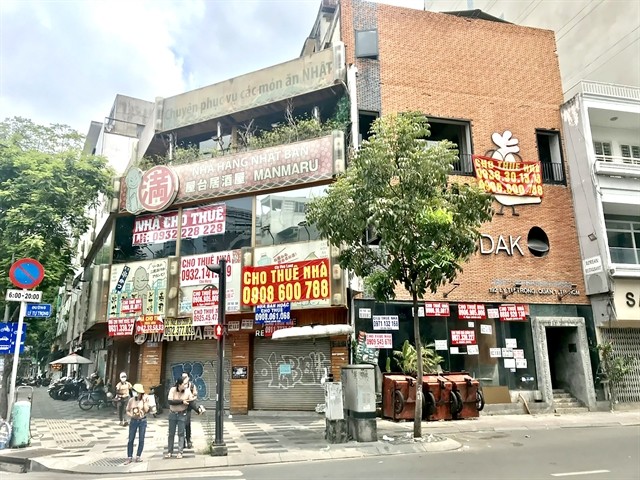
Vacant commercial properties have become increasingly common along major retail corridors such as Nguyen Hue, Dong Khoi, Ham Nghi and Nam Ky Khoi Nghia streets, while similar trends are emerging in other established commercial areas across the city.
Property brokers said demand for retail space weakened in the first half of this year, while the supply of available shop-houses increased by 20-30 percent compared with the same period last year.
To attract tenants, many landlords have lowered rents, reduced deposit requirements and offered longer fit-out periods.
According to data from Batdongsan.com.vn, asking rents for shop-houses across Ho Chi Minh City declined in the second quarter.
Some inner-city commercial areas recorded rental declines of up to 25 percent compared with the previous quarter, while city-center locations saw rents fall by nearly 9 percent.
The decline follows a brief recovery in 2025 and reflects mounting challenges facing retailers.
Operating costs continue to rise while consumer spending remains uneven.
According to the General Statistics Office, Ho Chi Minh City's consumer price index increased by 5.7 percent in the first five months compared with the same period last year, with 10 of 11 categories of goods and services recording price increases.
Market observers said the slowdown is not only cyclical but also reflects structural changes in the retail sector.
Cao Thi Thanh Huong, deputy director of research at Savills Ho Chi Minh City, said shop-houses had long benefited from high pedestrian traffic, strong brand visibility and limited supply, allowing landlords to charge premium rents.
However, the rapid expansion of e-commerce and omnichannel retail models has reduced retailers' dependence on physical storefronts as their primary sales channel.
"Physical stores are no longer the sole driver of revenue. They are increasingly becoming part of a broader ecosystem that combines both online and offline sales," she said.
Tighter management of sidewalks and public spaces has also reduced some of the advantages traditionally associated with street-front retail properties, she added.
As a result, many brands are downsizing their physical footprint, shifting towards smaller showrooms, experience centres and hybrid retail formats. Demand for large premises with high rents has consequently weakened.
Mai Vo, head of retail leasing at CBRE Vietnam, said shop-houses would remain an important part of the retail landscape but would likely see greater differentiation in the years ahead.
Businesses that rely heavily on walk-in customers, such as fashion, cosmetics and general consumer goods retailers, face increasing competition from e-commerce platforms.
In contrast, sectors requiring physical interaction, including education, healthcare, banking, personal services, entertainment and experiential showrooms, are expected to maintain more stable demand for retail space.
She noted that rental pricing is becoming increasingly tied to tenants' business performance rather than landlords' expectations or historical benchmarks.
More flexible leasing arrangements, including revenue-sharing agreements, shorter lease terms and the subdivision of retail space, may become more common as landlords adapt to changing market conditions, she said.
Analysts said the future of Ho Chi Minh City's shop-house market would depend less on whether rents return to previous peaks and more on how landlords and retailers adjust to evolving consumer habits and new retail models.
Properties with convenient locations, flexible layouts and competitive rents are expected to remain attractive, while those relying solely on prime street frontage may continue to face longer vacancy periods and downward pressure on rents.