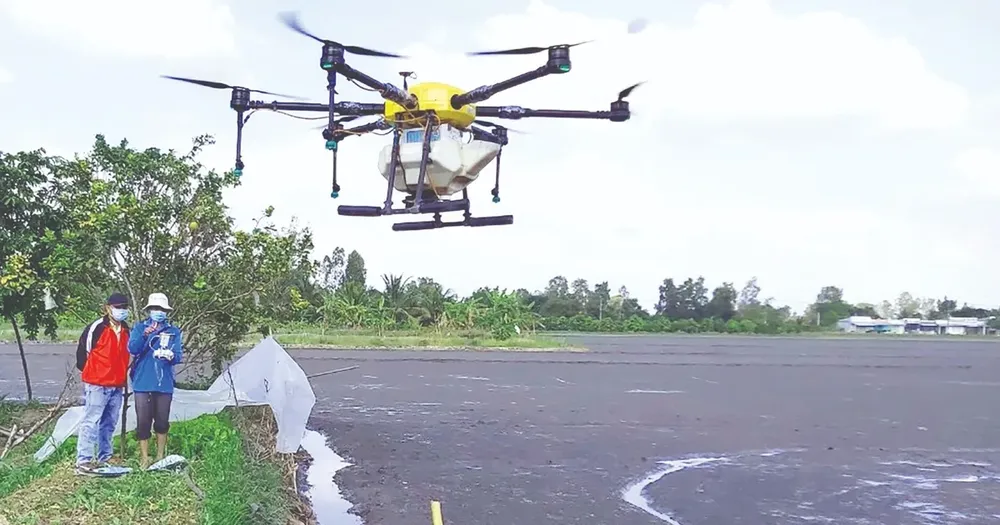
The Low-Altitude Economy (LAE) refers to economic activities occurring in airspace below 1,000 meters, potentially extending up to 5,000 meters. Previously underutilized, this airspace is transforming into “a new fertile ground” thanks to both manned and unmanned aerial vehicle (UAV) technology. Applications span from precision agriculture, smart logistics, and environmental monitoring to telecommunications and entertainment.
Many businesses recognize that, guided by Resolution 57-NQ/TW on breakthroughs in science, technology, and national digital transformation, as well as the Prime Minister’s Decision No. 1131/QD-TTg on strategic technologies, the LAE will play an increasingly critical role in the near future.
The global LAE market has reached hundreds of billions of USD, growing at 30 percent annually. Major economies like the US, China, and Europe define it as a strategic industry. China began deploying LAE development steps in 2023 with an initial scale of $69.8 billion, forecasting the market to exceed $500 billion by 2025.
Vietnam’s LAE potential is estimated at $10 billion. With policies encouraging innovation and a young, dynamic workforce, Vietnam is poised to become the region’s low-altitude industrial hub.
Positive initial signals of the LAE in Vietnam have emerged across various sectors. UAVs have been tested for relief delivery in the provinces of Thai Nguyen, Tuyen Quang, and Bac Ninh, and for automated delivery at the Lang Son Logistics Zone. These initiatives help shorten delivery times, reduce costs, and overcome topographical limitations. These trials demonstrate the feasibility of low-altitude logistics, particularly as Vietnam’s e-commerce sector is forecast to reach $63 billion by 2030.
Chief Technology Officer Vu Anh Tu of FPT Corporation (a member of the Vietnam UAV Association network), noted: “UAVs are also expected to become powerful tools for infrastructure monitoring, traffic management, and enhancing emergency response capabilities.”
Experts assess that Vietnam is facing a golden moment to unlock an entirely new economic sector based on UAV technology. CTO Vu Anh Tu argued that the LAE ecosystem is not limited to UAV research and manufacturing but encompasses chips, sensors, flight management platforms, 3D digital mapping, training, and other fields.
“The LAE opens up new growth momentum, where Vietnam can take off using intellect, technology, and multi-dimensional cooperation between the state, businesses, research institutes, and the people. By seizing the opportunity and investing in the LAE, we are promoting three pillars of the new era: the digital economy, the green economy, and the creative potential of Vietnamese engineers and scientists, affirming Vietnam’s position on the global technology map,” CTO Vu Anh Tu emphasized.
From a production reality perspective, Chairman Tran Kim Chung of CT Group Vietnam stated that the LAE is not a solitary industry but a comprehensive economic ecosystem, integrating elements of both the green and digital economies.
In agriculture, a single UAV can spray pesticides and monitor 67 hectares of crops per day. In the power sector, one hour of UAV work can be equivalent to 3 working days of a line inspection worker. Clearly, this leap in productivity is measured not in percentages but in multiples of ten, serving as a key factor in economic development.
He believes developing the LAE in Vietnam will yield numerous strategic benefits, such as creating significant value-added because the LAE “mirrors the terrestrial economy in the sky,” covering fields from agriculture and logistics to construction. The combination of these sectors will continue to generate new business models.
Furthermore, the LAE provides effective tools to address major national challenges such as food security, traffic congestion, environmental pollution, and climate change response. Mastering this high-tech integrated economy will grant Vietnam a distinct position on the international stage.
Vietnam established the Low-Altitude Economy Alliance, which debuted on October 10, 2025, with Nguyen Van Khoa, CEO of FPT Corporation, serving as Chairman. The Alliance expects this new economy to stimulate thousands of auxiliary businesses, create 1 million high-quality jobs, and generate tens of billions of USD for Vietnam over the next 10-15 years.