Saving over VND1.5 trillion on monthly electricity bills
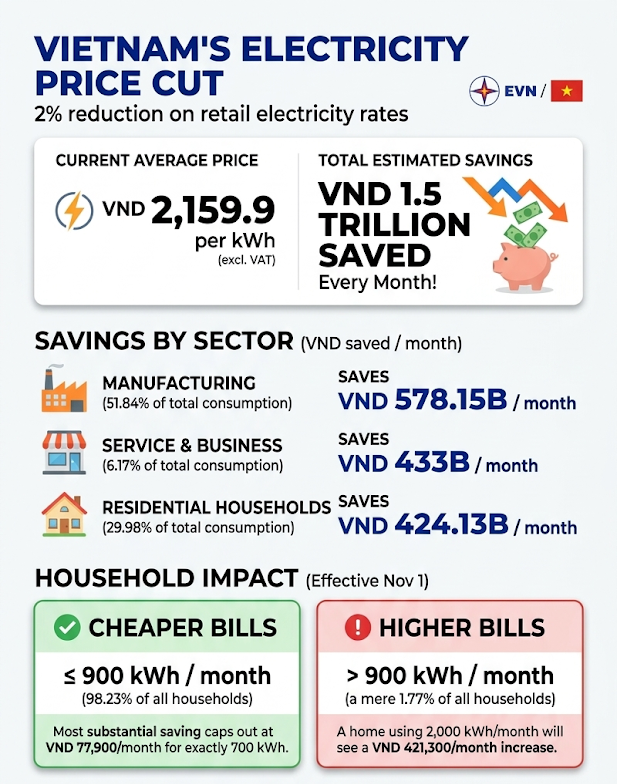
Following the 2-percent cut, the current average retail electricity price stands at VND2,159.9 (US$0.08) per kWh, excluding value-added tax. With this reduction, Vietnam Electricity (EVN) estimates that the total electricity cost for all customer groups will plummet by VND1.5 trillion ($58.4 million) every single month.
Specifically, manufacturing clients, who consume 51.84 percent of the total electrical output, will save VND578.15 billion ($22.5 million). The service and business sector, accounting for 6.17 percent of output, will see a drop of VND433 billion ($16.8 million). Meanwhile, residential households, making up 29.98 percent of total consumption, will enjoy a reduction of VND424.13 billion ($16.5 million). The remaining customer brackets will also secure a partial cut in their electricity expenses.
For Head of EVNs Business and Electricity Trading Department Nguyen Quoc Dung, the consumption tiers were deliberately redesigned to better align with the practical electricity usage patterns of modern households.
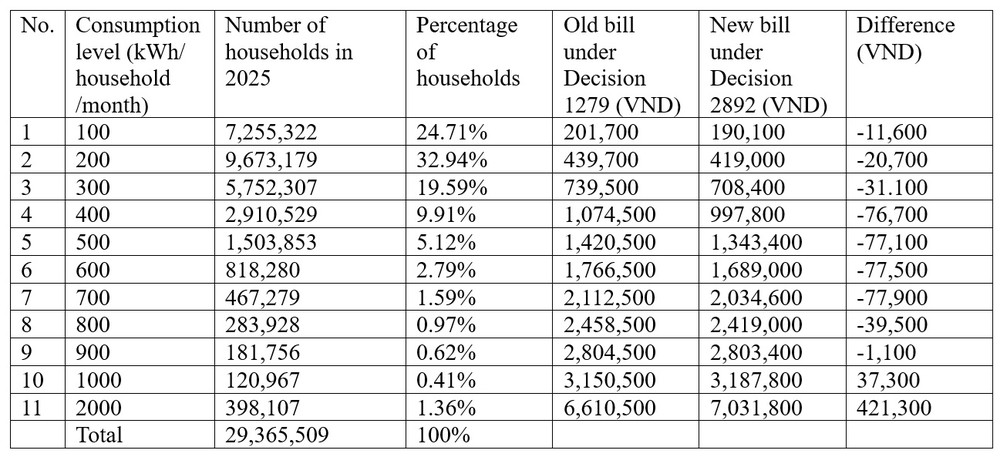
Based on 2025 customer data, EVN calculates that households utilizing no more than 900 kWh per month (representing 98.23 percent of all consumers) will undeniably enjoy a cheaper electricity bill starting November 1. The most substantial monthly saving caps out at VND77,900 ($3.03) for those consuming exactly 700 kWh.
Conversely, it’s expected that homes burning through over 900 kWh monthly (constituting a mere 1.77 percent of total households) will actually have to pay more. For instance, a household consuming 2,000 kWh per month will face an increase of VND421,300 ($16.4) monthly. Alongside the cut in the average retail rate, the residential electricity price rate structure has been streamlined from six tiers down to five.
Mr. Nguyen Quoc Dung also reported that the Ministry of Industry and Trade has actively tweaked the peak, normal, and off-peak timeframes under Decision No. 963/QD-BCT, dated April 22, 2026. The three-timeframe pricing initially applies strictly to eligible clients within the manufacturing and commercial sectors, who currently purchase electricity under the three-rate mechanism. This specific regulation doesn’t yet apply to residential households.
Therefore, compressing the residential price rate from six down to five tiers and adjusting the time-of-use pricing frameworks are essentially two distinct policy shifts targeting completely disparate customer brackets.

Needs for continuously slashing input costs
For General Director Tran Huy Thu of Vietnam Petrochemical and Fiber JSC, peak production periods can push the enterprise’s electricity bill up to a staggering VND30 billion ($1.17 million) monthly. “With a 2-percent rate cut, our business can manage to stash away VND600 million ($23,342) every month,” he explained.
Echoing a similar stance, Chairman Nguyen Hong Sy of the Board of Members at Lilama 18 JSC emphasized that electricity and fuel remain critically vital input factors. Slashing electricity bills acts as a solid lifeline to help enterprises maintain manufacturing and commercial operations, but it must be synchronized with support regarding interest rates and taxation.
Touching upon the timeframe adjustments, Deputy General Director Chu Huu Nghi of Hung Yen Garment Corporation pointed out that his enterprise will have to reshuffle operating hours and production shifts to curb cost hikes under the new time-of-use pricing.
Currently, the corporation has primarily scheduled its manufacturing activities within normal and off-peak windows. However, when the year-end order volume spikes, the business might have to push working shifts earlier, a move that could initially leave laborers struggling to acclimate to the jarring new rhythm.
According to Chairman Nguyen Tien Thoa of the Vietnam Valuation Association, a 2-percent electricity price cut can help drag down the production cost of steel by 0.12 percent, cement by 0.3 percent, and textiles by 0.23 percent. Cutting electricity prices exerts a profoundly positive impact on wrestling down inflation. The 2-percent reduction could potentially drive the consumer price index (CPI) down by 0.0662 percent during the direct impact phase, and by 0.1324 percent if subsequent ripple effects are factored into the equation.
Vice Chairman Nguyen Quang Vinh of the Vietnam Chamber of Commerce and Industry (VCCI) acknowledged that slashing energy prices inherently helps businesses alleviate intense cost pressures. Yet, the tangible real-world efficacy still heavily depends on the sheer volume of electricity consumed, the specific price rate structure, and each enterprise's innate agility in overhauling its operations.
Impact of electricity price adjustments
The 5-tier residential electricity price rate (excluding VAT)
- Tier 1 (0-100 kWh): VND1,901 per kWh
- Tier 2 (101-200 kWh): VND2,289 per kWh
- Tier 3 (201-400 kWh): VND 2,894 per kWh
- Tier 4 (401-700 kWh): VND 3,456 per kWh
- Tier 5 (701 kWh and above): VND 3,844 per kWh
Businesses desperately need to capitalize on this supportive window to thoroughly audit their energy consumption quotas, control costs at every single stage, upgrade outdated equipment, and radically boost their overall electricity utilization efficiency. Enterprises must architect backup contingencies to weather volatile fluctuations in fuel prices and logistical costs, while simultaneously baking these critical variables into their production blueprints and contractual negotiations.
“The five-tier residential electricity price rate represents a highly positive reform, effectively streamlining the billing calculus, fostering greater transparency, and encouraging energy conservation. However, the glaring point of concern remains pure fairness because a populous household isn’t necessarily burning through electricity wastefully, yet they might still get slapped with steep rates. Any electricity pricing reform must, therefore, strictly guarantee three core mandates. Low-income earners are thoroughly protected, thrifty electricity consumers are heavily incentivized, and all users pay an amount truly commensurate with their consumption footprint.”
Assoc Prof Dr Ngo Tri Long – Vietnam Financial Consulting Association