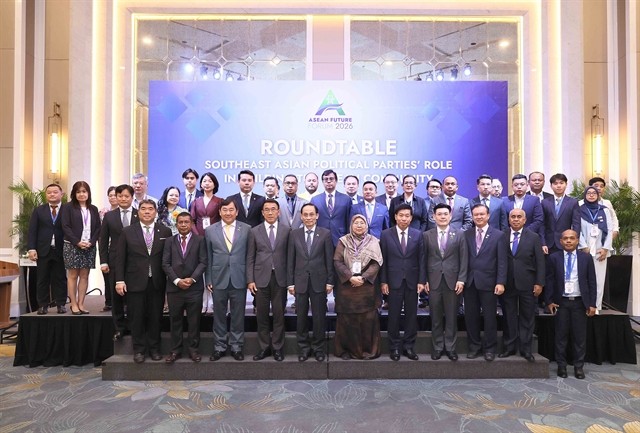
A seminar on the role of Southeast Asian political parties in building the ASEAN Community was held in Hanoi on June 8 as part of the third ASEAN Future Forum (AFF), with delegates emphasising that stronger inter-party cooperation can help deepen regional solidarity, strengthen political trust, and make ASEAN more people-centered.
In his opening remarks, Vietnamese Minister of Foreign Affairs Le Hoai Trung described the dialogue as a landmark for ASEAN cooperation, marking the first-ever exchange among political parties from across Southeast Asia.
He noted that the meeting took place against the backdrop of profound global and regional changes that are affecting countries, societies and political parties alike. Southeast Asian countries are facing new challenges in pursuing socio-economic development as traditional growth drivers encounter obstacles.
Trade liberalisation, globalisation, and regional and international economic integration are facing growing headwinds. Southeast Asia, like many other regions, continues to confront the risk of supply chain disruptions. While the Asia-Pacific remains a key driver of global economic integration, the region is operating in an increasingly uncertain security environment, and its economic outlook continues to face significant challenges and uncertainties.
According to the minister, ASEAN’s consensus-based approach – long regarded as one of the key factors behind the bloc’s success in building a united and cohesive community – is facing increasing obstacles in fostering dialogue inside and outside ASEAN. International law and multilateral institutions are confronting unprecedented challenges. Conflicts continue to erupt and evolve in ways that would have been difficult to imagine just a few years ago. As a result, the foundations of peace and stability that underpin development are becoming increasingly fragile at both the regional and global levels.
Despite these challenges, Minister Le Hoai Trung expressed his belief in ASEAN’s future. He said that over nearly six decades, ASEAN has transformed Southeast Asia into a region characterised by cooperation, integration, trust and prosperity. The grouping has also established itself as an important platform for dialogue and cooperation among countries within and beyond the region.
To maintain unity and strategic autonomy in a rapidly changing world, ASEAN cooperation should extend beyond government and parliamentary channels and be reinforced through political parties, he said, stressing that stronger inter-party cooperation is not merely an exchange initiative but a strategic necessity.
Political parties, he added, can help bring ASEAN closer to its people by serving as a two-way bridge between regional policies and public aspirations. Their engagement can mobilise broader social consensus and support collective responses to common challenges, including climate change, cybersecurity, sustainable development and the digital economy.
The dialogue featured three discussion sessions and nearly 20 presentations by representatives of political parties, scholars and experts from across the region. Speakers shared the view that political parties have a shared responsibility to contribute to a peaceful, stable and sustainable ASEAN and reaffirmed their commitment and determination to supporting ASEAN Community-building efforts, Minister Le Hoai Trung said.
In his closing speech, Deputy Foreign Minister Nguyen Manh Cuong said the discussions had highlighted the need and the great potential for strengthening dialogue through political-party channels. Such exchanges, he said, can enhance political trust, deepen mutual understanding and foster intra-group solidarity towards building a cohesive, resilient and people-centred ASEAN Community.
Dialogue among political parties has become an important part of the region’s political trust infrastructure – a space where ideas, experiences and consensus can be accumulated to facilitate long-term ASEAN cooperation, Cuong said.
He reaffirmed that promoting cooperation with political parties in Southeast Asia and the globe remains a priority in Vietnam’s foreign policy and international integration efforts.
Deputy Foreign Minister Nguyen Manh Cuong expressed his belief that political parties deserve a greater role in shaping the future of the ASEAN Community, not only through contributing to policymaking and building a common regional vision, but also by building domestic consensus within their respective countries. Such efforts, he said, form the foundation for regional peace, stability, and prosperity.
Summarising the outcomes of the dialogue, Deputy Foreign Minister Nguyen Manh Cuong said participants reached broad consensus in three key areas, including strengthening trust, mutual understanding and dialogue among political parties; as well as between parties, think tanks and academic institutions, as a means of reinforcing ASEAN unity, resilience, and central role amid growing uncertainties in the region and the world.
Participants also agreed that political parties should play a more proactive role in advancing initiatives and ideas to support the realisation of goals of the ASEAN Community Vision and its strategic plans to 2045, towards ensuring that the bloc remains inclusive, sustainable, and people-centered.
They further reaffirmed the growing importance of political parties in policymaking, promoting regional cooperation, and sharing governance experience to help ASEAN respond effectively to shared challenges and adapt to an evolving regional landscape.
Several delegates also proposed establishing more regular exchange mechanisms among political parties. Deputy Foreign Minister Nguyen Manh Cuong said such a platform could facilitate sustained dialogue among political parties, scholars, research institutes and strategic policy centres, while generating recommendations and cooperation initiatives to support ASEAN in effectively addressing emerging challenges while advancing the implementation of the ASEAN Community Vision 2045.