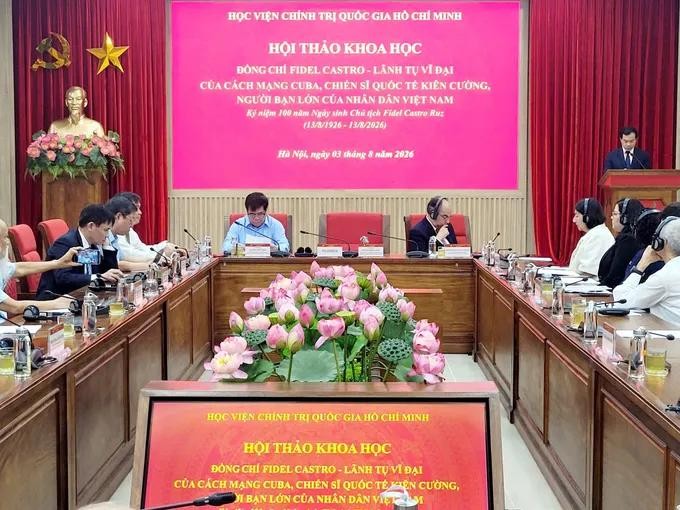
The Ho Chi Minh National Academy of Politics held the scientific conference titled "Comrade Fidel Castro – Great Leader of the Cuban Revolution, Resolute Internationalist, and Great Friend of the Vietnamese People" in Hanoi.
The event was organized to commemorate the 100th anniversary of Fidel Castro's birth (August 13, 1926 – August 13, 2026).
The conference focused on examining Fidel Castro's life, career, and contributions to the Cuban Revolution and the national liberation movement, while analyzing the content and significance of his ideological legacy.
It also reaffirmed the sincere and selfless support that President Fidel Castro and the Cuban people extended to Vietnam, as well as the enduring value of the special solidarity between Vietnam and Cuba in the current context.
In his opening remarks, Associate Professor Nguyen Manh Hung, Vice Director of the Ho Chi Minh National Academy of Politics and Vice Chairman of the Central Theoretical Council, reviewed Fidel Castro's distinguished revolutionary career and the ideals that transcended national borders.
According to Associate Professor Nguyen Manh Hung, Fidel Castro was a steadfast internationalist and an outstanding theorist and practitioner of the international communist and workers' movement. For national liberation movements and the global socialist cause, he remained a shining example of unwavering determination, resilience in the face of great-power pressure, and commitment to safeguarding national independence, sovereignty, and justice.
The relationship between the two Parties, the two States, and the peoples of Vietnam and Cuba, established by President Ho Chi Minh and President Fidel Castro and nurtured by successive generations of leaders and citizens of both countries, has become a model symbol of fraternal solidarity, comprehensive cooperation, and mutual trust in the history of international relations.
Vietnam will never forget President Fidel Castro's immortal words, spoken during the fiercest years of the resistance war against the United States: 'For Vietnam, Cuba is willing to shed even its own blood. His image proudly raising the flag of the National Liberation Front of South Vietnam in a liberated area has become a lasting symbol of the steadfast fighting solidarity between the two nations on opposite sides of the globe, Associate Professor Nguyen Manh Hung said.
Rogelio Polanco Fuentes, Cuba's Ambassador to Vietnam, described the conference as a special tribute to Fidel Castro in Vietnam—a country he deeply admired for its heroic tradition of struggle and to which he devoted himself through his commitment to internationalism and solidarity.
According to Ambassador Fuentes, Fidel Castro's ideology is best embodied in his concept of revolution, founded on profound moral and humanistic values, a strong sense of justice, patriotism, internationalism, and opposition to imperialism.
The conference brought together numerous scholars, diplomats, and historical witnesses, featuring 30 presentations. Key topics included Fidel Castro's role in opening a new chapter in the national liberation movement in Cuba, Latin America, and the world; his views on the contemporary era and the inevitable development of socialism; his thinking on economic independence alongside political self-reliance under blockade and sanctions; his vision for the exemplary Cuba–Vietnam relationship; and the enduring significance of his famous declaration, "For Vietnam, Cuba is willing to shed even its own blood," as both an ideal and a lasting symbol of solidarity.