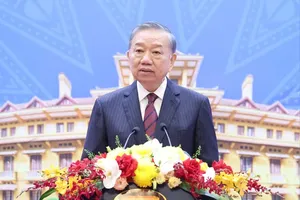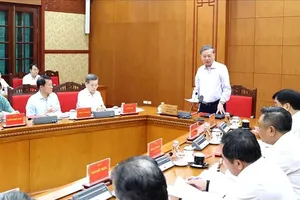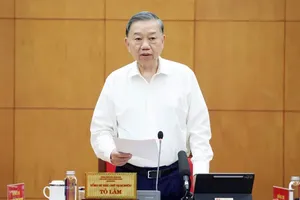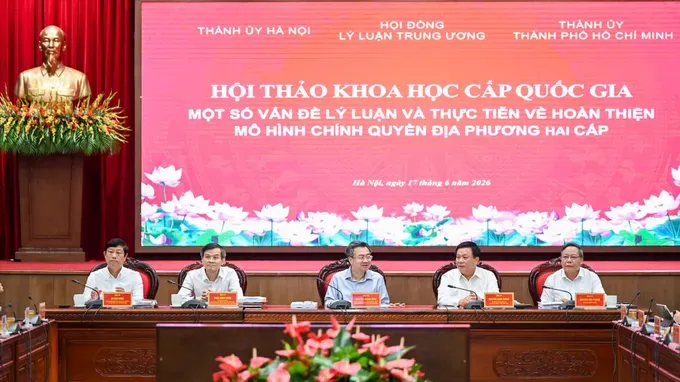
Delivering the opening remarks, Hanoi Party Committee Deputy Secretary Nguyen Van Phong emphatically stressed that after a period of practical operation, the two-tier local government model has initially managed to showcase its inherent strengths.
However, the rollout process has undeniably brought forth several agonizing issues that must be continuously researched, summarized, and evaluated in a highly objective, rigorously scientific, and entirely comprehensive manner.
This essentially entails perfecting the institutional framework, streamlining decentralization and power delegation, strictly defining jurisdictions, organizing the administrative apparatus, and building the cadre contingent, while simultaneously guaranteeing the necessary conditions for robust digital infrastructure, data management, professional workflows, and seamless coordination mechanisms among various administrative echelons and sectors.
This seminar serves as an invaluable opportunity for central agencies, local authorities, experts, scientists, and those directly involved in executing leadership and management to openly exchange views, meticulously clarify the underlying theoretical foundations, rigorously evaluate practical operations, and accurately pinpoint the agonizing difficulties, deeply-rooted bottlenecks, and emerging issues.
Simultaneously, they aim to identify the exact root causes and propose highly feasible solutions for further perfecting the two-tier local government model in the foreseeable future.
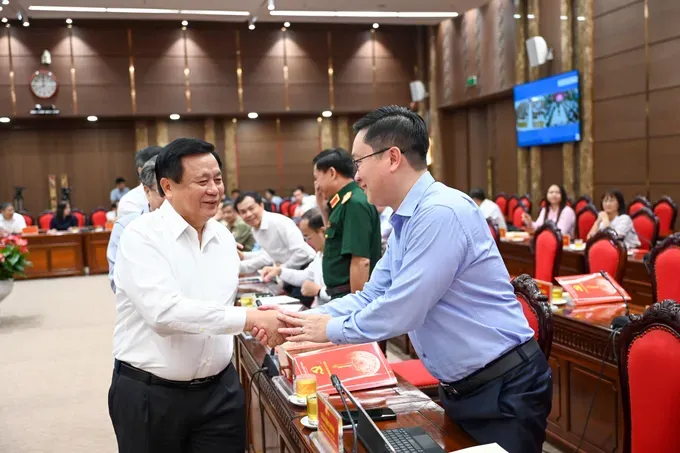
During his keynote introductory speech, Chairman of the Central Theoretical Council Prof Dr Nguyen Xuan Thang prompted and requested participating leaders, scientists, experts, and delegates to intensely converse and shed light on the initial triumphs, glaring hurdles, inherent limitations, underlying causes, and hard-earned experiential lessons gleaned directly from implementing the two-tier local government model, drawing from the on-the-ground realities of Hanoi and HCMC.
It’s absolutely crucial to take an intensive dive into newly emerging issues surrounding apparatus organization, systemic decentralization and empowerment, personnel work, sheer digital transformation efforts, local governance, power control, and grassroots democracy. At the same time, participants were urged to share brilliant approaches, effective models, and creative experiences, while pointing out the agonizing obstacles hindering the operational process.
A profoundly vital lesson that desperately needs to be dissected at the seminar is the transition from a purely managerial mindset to a constructive and developmental one, which requires paying extremely close attention to the meticulous directives of General Secretary and State President To Lam.
Prof Dr Nguyen Xuan Thang also earnestly requested delegates to dissect viable solutions specifically designed to further refine the institutional framework, organizational structure, operating mechanisms, and overarching technological platforms of the two-tier local government model.
Furthermore, he asked them to recommend concrete guidelines, robust policies, and major strategic decisions that must be rolled out in the coming time. In tandem with this, they must bring crystal-clear clarity to the precise methods of guaranteeing that delegated powers remain clear, inherent responsibilities are transparently pinpointed, workflows are rigorously standardized, and authority is distinctly delineated.
Squarely within this context, decentralization and power delegation must walk hand in hand with genuine empowerment, strategic resource allocation, elevated enforcement capacity, and the firm establishment of strict power-control mechanisms.
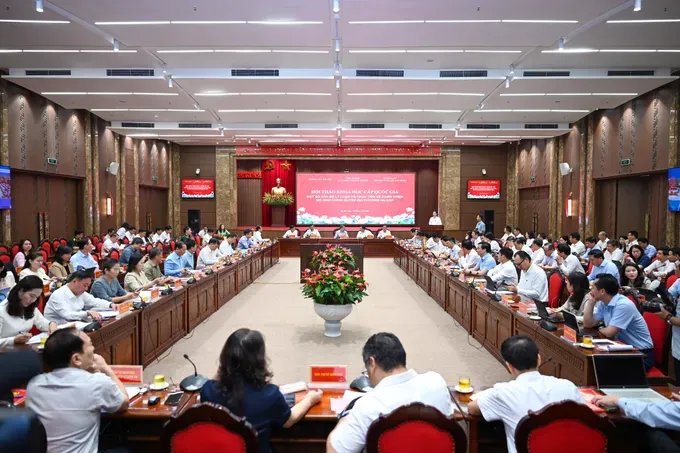
According to Prof Dr Nguyen Xuan Thang, to operate effectively, one simply can’t assign an arduous task without simultaneously providing the adequate conditions, necessary tools, capable manpower, vital data, and protective mechanisms. An incredibly vital prerequisite in the grand scheme of decentralization is fiercely protecting those daring cadres who boldly think outside the box and act decisively for the collective good.
This guarantees the core principles of substantive empowerment, transparent oversight, results-based evaluations, which in turn safeguards those who do things right and severely penalizes the bad actors who knowingly err.
“Wherever power is delegated, it must be relentlessly monitored right there; decentralization simply must be intrinsically linked with ironclad discipline and the rigorous supervision of actual results,” he stressed.
Prof Dr Nguyen Xuan Thang expressed his unwavering belief that the seminar will massively contribute to summarizing practical realities, perfecting theoretical frameworks, accurately identifying entirely new problems, and proposing highly feasible solutions to continuously polish the two-tier local government model. Through these concerted efforts, the nation can successfully meet its developmental demands, achieve double-digit growth, and triumphantly soar into a brand-new era.