Vietnam, as coordinator of the ASEAN-EU economic relations and Chair of the Comprehensive and Progressive Agreement for Trans-Pacific Partnership (CPTPP) in 2026, has affirmed its readiness to act as a bridge, deepening connectivity and complementarity between the two blocs.
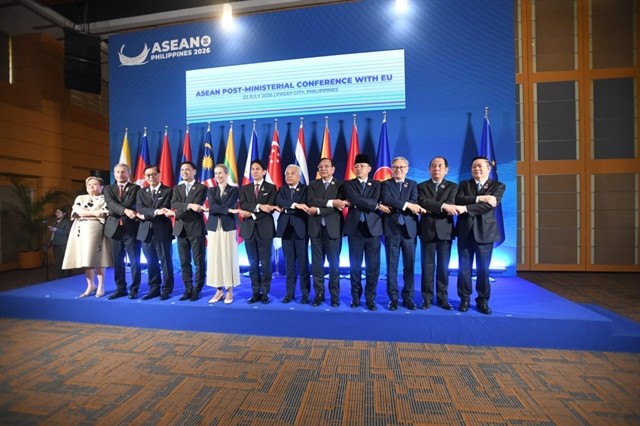
The message was delivered at the ASEAN Post-Ministerial Conference with the EU in Manila, the Philippines on July 22, as part of the 59th ASEAN Foreign Ministers’ Meeting (AMM-59) and relevant meetings.
The conference was co-chaired by Brunei’s Foreign Minister Abdul Mateen and Vice-President of the European Commission and the EU High Representative for Foreign Affairs and Security Policy Kaja Kallas.
The Vietnamese delegation stressed that ASEAN and the EU share both the responsibility and common interest in promoting peace, stability, compliance with international law and multilateralism, and insisted cooperation must continue to be built on trust, mutual understanding and respect.
Looking ahead, Vietnam proposed the two sides prioritise stronger regional resilience by scaling up energy cooperation, pooling financial resources and cracking down on illegal, unreported and unregulated fishing, all aimed at building a resilient and sustainable blue economy.
Against a backdrop of mounting strain on multilateral institutions, Vietnam urged ASEAN and the EU to intensify coordination in promoting dialogue, trust building and upholding of multilateralism and international law, while also proposing deeper cooperation in crisis prevention, response and management, maritime security and safety, thus making practical contributions to peace, stability and sustainable development in the region and beyond.
Kallas, in her speech, said the EU is eager to continue working with ASEAN to drive peace, security, stability and multilateralism, while advancing the peaceful settlement of disputes in line with the UN Charter and international law, and called for tighter cooperation on trade, maritime security, transnational crime, connectivity, people-to-people exchanges, climate response and energy transition.
She also reaffirmed the EU’s commitment to upgrading ties to a Comprehensive Strategic Partnership and backed the idea of a Commemorative ASEAN-EU Summit in 2027 to mark 50 years of dialogue relations.
Reviewing the past year, ministers welcomed steady progress under the ASEAN-EU Plan of Action 2023–2027, with 69.5 percent of action lines completed or underway. The EU remains ASEAN’s third largest trade partner and top source of foreign direct investment. Bilateral trade hit an estimated US$320.19 billion in 2025, while EU’s FDI into ASEAN hit US$31.76 billion.
Their cooperation has delivered concrete results in political-security affairs, digital transformation, connectivity, supply chain resilience, green transition, renewable energy, disaster management, climate action, education and people-to-people exchanges, bolstering the region’s adaptability and resilience.
Both sides will soon craft a new Plan of Action and widen cooperation to include resilience, digital transformation, energy security and maritime security. They also agreed to keep discussing the 2027 Commemorative Summit and an upgrade of the current partnership framework.