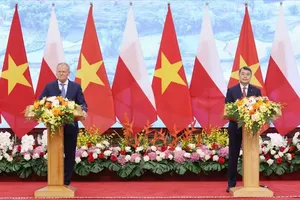
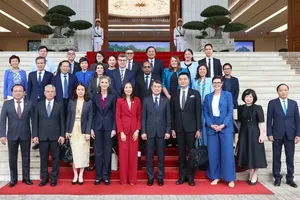
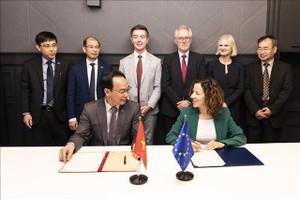
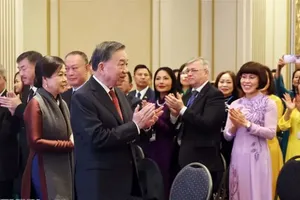
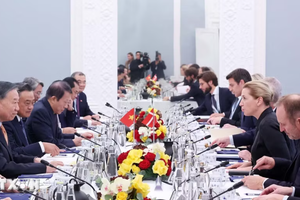
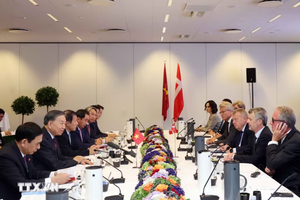
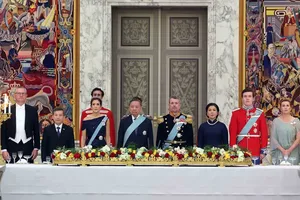
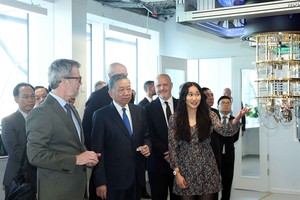
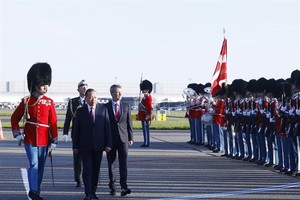
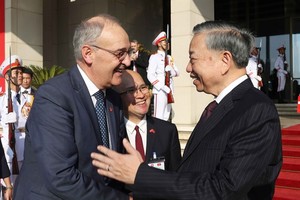
The event, jointly organised by Vietnam’s Ministry of Industry and Trade and Poland’s Ministry of Economic Development and Technology, brought together leaders of ministries and agencies and business representatives from both countries.
Bilateral trade targeted at US$6 billion
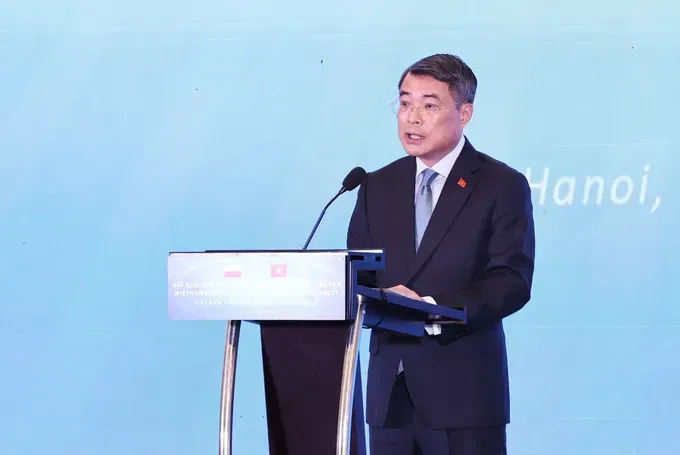
In his remarks, PM Le Minh Hung stressed that the business roundtable took place shortly after the two countries’ leaders officially announced the elevation of bilateral ties to a Strategic Partnership – a milestone reflecting deep political trust, a shared vision and a determination to elevate their traditional friendship to a new height.
He expressed his hope that the event would help translate the newly established Strategic Partnership framework into long-term economic, trade and investment cooperation initiatives, programmes and projects, particularly in areas where the two countries have complementary strengths and potential, in line with the needs and interests of their people and businesses and the development priorities of both countries.
The PM noted that economic, trade and investment cooperation constitutes a key pillar of bilateral relations. Poland is currently Vietnam’s largest trading partner in Central and Eastern Europe. Bilateral trade has maintained steady growth, reaching nearly US$4 billion in 2025, up 14.8 percent from 2024, and nearly US$3.5 billion in the first nine months of 2026, a year-on-year increase of 19 percent.
Given Poland’s important position in Central and Eastern Europe and Vietnam’s in Southeast Asia, the two countries have considerable potential and favourable conditions to connect markets, strengthen production links, develop supply chains and expand investment, he said.
Poland has strengths in pharmaceuticals, healthcare, defence, renewable energy, digital transformation, smart agriculture, railways, shipbuilding and environmental technologies, while Vietnam offers processing and manufacturing capabilities, a seaport system, abundant human resources and a network of 18 free trade agreements with more than 60 partners.
By better connecting these complementary strengths, the two sides could establish more competitive and efficient production, supply and distribution chains, PM Le Minh Hung said, affirming that the target agreed upon by the two countries’ leaders of raising bilateral trade to US$6 billion was achievable if their governments and businesses worked together.
To elevate economic, trade and investment cooperation in line with the Strategic Partnership, he called for improvements in the quality of collaboration. He welcomed the participation of Polish businesses and organisations operating in healthcare, pharmaceuticals, defence industries and space technology, describing the roundtable as an opportunity for direct engagement, information exchange and exploration of new cooperation areas with high scientific and technological content and added value.
In that spirit, Vietnam encourages Polish enterprises to expand cooperation and investment in the country, particularly in sectors of Poland's strengths that align with Vietnam’s sustainable development needs, including renewable energy, smart agriculture, digital transformation, railways, shipbuilding and environment, accompanied by technology transfer and a commitment to sustainable development, he said.
PM Le Minh Hung urged the two sides to review and promptly address barriers related to institutions, policies, investment procedures, immigration, customs, standards and technical regulations. He also called for promoting dialogue mechanisms between businesses and relevant ministries and agencies, including the annual Vietnam Business Forum, which brings together representatives of European organisations and enterprises, including those from Poland.
He also underscored the need to improve transport connectivity to facilitate market access. Welcoming Polish national carrier LOT’s plan to resume direct flights between Warsaw and Hanoi, he called on relevant agencies to explore diversified transport links between the two economies, including air and maritime routes, as well as the possibility of establishing rail connections to complement traditional maritime transport between Asia and Europe.
The two countries’ businesses should strengthen partnerships, uphold social responsibility and pursue sustainable business practices, he said, calling on Poland to facilitate Vietnamese enterprises’ participation in production and supply chains, prioritise the recruitment and training of local workers, and pledge long-term investment and cooperation using modern, environmentally friendly technologies.
Affirming that “business growth drives national development”, PM Le Minh Hung pledged that the Vietnamese Government would continue supporting businesses and investors and creating the most favourable conditions for effective, stable and sustainable cooperation between enterprises from both countries.
He called on the business communities to take a pioneering role, proactively seeking partners and developing projects with substantial economic value and wider spillover benefits for both sides.
With a solid foundation of friendship, consensus among senior leaders and the dynamism of the two countries’ business communities, he expressed his belief that Vietnam-Poland relations would continue to grow strongly, matching the stature of their Strategic Partnership and contributing to the prosperity of both nations.
Boosting investment in pharmaceuticals, defence and high-tech industries
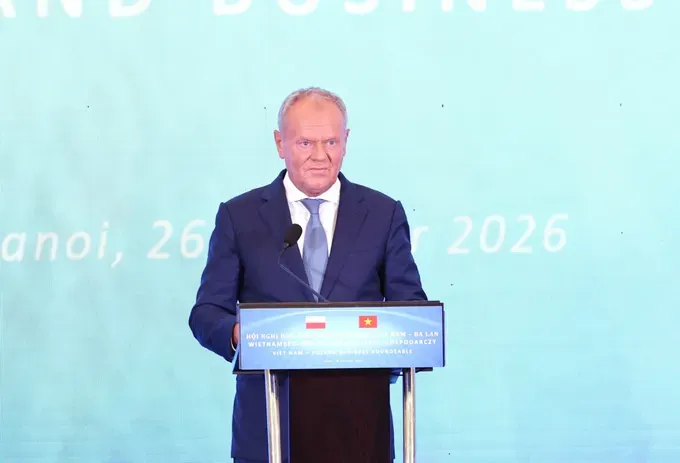
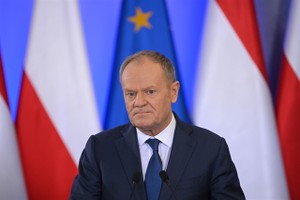
Polish PM Tusk described the roundtable as an important opportunity for the two sides to discuss prospects for economic cooperation, focusing primarily on specific projects, investments and opportunities to build long-term business partnerships.
He emphasised that Vietnam is one of Asia’s most dynamic economies and an important link in global supply chains. Over recent decades, Vietnam has made impressive strides in development, emerging as a major export hub. The country now has even greater ambitions to develop a modern technology sector, invest in advanced technologies and increase the share of high-value-added products in its economy.
He expressed his confidence that the experience and potential of the two countries could complement each other, laying the groundwork for closer economic ties.
He noted that bilateral economic, trade and investment cooperation had achieved significant results in recent years, but the structure of bilateral trade remained uneven and two-way investment had yet to reach a level commensurate with the potential of both economies.
The two sides therefore need to work together to expand and diversify trade, develop new export opportunities and create more favourable conditions for investment, he said, adding the EU-Vietnam Free Trade Agreement (EVFTA), which entered into force in 2020, provides a framework to support these efforts.
PM Tusk also highlighted several sectors with significant potential to deepen the Poland-Vietnam partnership, including pharmaceuticals and healthcare, defence and dual-use technologies, the space industry and high technology.
In pharmaceuticals and healthcare, he said Polish investment could effectively support the development of Vietnam’s pharmaceutical industry. Cooperation could encompass further investment, research, manufacturing development and exports of medicines and medical products to other regional markets.
Such projects could benefit both sides by creating jobs, strengthening domestic industries and improving access to modern technologies, he noted.
Regarding defence and dual-use technologies, PM Tusk said Poland was rapidly developing its defence industrial capabilities. Polish companies supply advanced unmanned aerial vehicle systems, communications technologies, electronics, optoelectronics and security solutions. Many of these technologies also have civilian applications in industry, transport and the protection of critical infrastructure.
In the space and high-tech sectors, Poland is developing capabilities in satellite technologies, electronics, optical systems, advanced software and data analytics. Polish companies and research institutes participate in European space projects, supplying specialised components and advanced technological solutions. Vietnam, meanwhile, is investing in developing its own satellite and space technology capabilities.
PM Tusk said the two countries could jointly develop solutions for Earth observation and satellite data analytics, as well as applications in agriculture, water resource management, environmental protection and infrastructure management, particularly through the integration of space technologies and artificial intelligence.
He expressed his hope that Polish and Vietnamese companies would go beyond supplying technologies to each other and work together to develop new products, build capabilities and commercialise solutions in international markets.
Emphasising the shared ambition to move beyond traditional trade toward deeper investment and industrial cooperation, he said Polish businesses could contribute technology, expertise and capital, while Vietnamese partners could offer advanced manufacturing infrastructure, market knowledge and regional expansion capabilities.
The Polish leader invited business representatives to share their investment plans, opportunities for expansion in Vietnam and the support they would need to implement their projects. He also encouraged participants to hear the perspectives of Vietnamese partners, understand their expectations of foreign investors and explore opportunities for growth alongside local businesses.
Building on the longstanding friendship between the two countries, he expressed his hope that similar business forums in the near future would lead to new investments, joint industrial projects, commercial contracts and technologies developed by Polish and Vietnamese companies.
At the event, Vietnamese and Polish officials and business representatives delivered presentations, shared experience and discussed prospects for cooperation and investment in sectors including aviation, pharmaceuticals, defence and the space industry.
Poland is one of Europe’s dynamic economies, with strengths in industry, science and technology, logistics and distribution networks. It also serves as an important gateway to Central and Eastern Europe. Meanwhile, Vietnam holds a strategic position in ASEAN and is a dynamic economy deeply integrated into the global economy, with extensive economic links to major markets worldwide.
These complementary strengths create favourable conditions for Polish businesses to expand in Vietnam and across ASEAN, while enabling Vietnamese companies to strengthen their presence in Poland and gain deeper access to the European Union market.
The EVFTA continues to provide a favourable framework for businesses in both countries to expand markets, capitalise on trade preferences and strengthen supply chain links.