Philippine President Benigno Aquino said Wednesday his country was "open for business" during a visit to Beijing as he set about wooing Chinese investors in tourism, agriculture and infrastructure.
Aquino, on a mission to secure billions of dollars in business deals, vowed to rid the Philippines of corruption and ensure foreign companies "are met with a level playing field" during a five-day visit.
"Investors will not any more have to rely on connections in order to set up shop; the rules will not be circumvented and the law will be followed, creating an environment that is stable and predictable," Aquino told a trade forum in the Chinese capital.
Aquino's visit, which ends Saturday, comes against the backdrop of increasingly strident Philippine accusations of Chinese aggression and bullying in their dispute over competing claims to parts of the South China Sea.
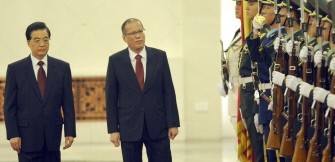
Aquino is expected to raise the sensitive issue in his meetings with China's leaders, including President Hu Jintao on Wednesday, but his main focus will be on improving economic ties.
Philippine Foreign Affairs Assistant Secretary Cristina Ortega announced last week that Manila hopes to sign a five-year economic plan that would target $60 billion in two-way trade in 2016, a six-fold rise from 2010.
"In the past our commercial relations have been more beneficial to you than to us. Now, we have come here to balance the equation," Aquino said, according to a copy of his speech to the trade forum.
"I now invite the Chinese business community to take part in this opportunity to invest in an emerging economic force... the Philippines is indeed open for business."
China, with an eye on the Philippines' vast and mostly untapped natural resources, has also signalled it does not want the maritime tensions to derail a flourishing economic partnership.
Hu said Wednesday Aquino's visit would "elevate the strategic and cooperative relationship" between China and the Philippines, ahead of talks between the two leaders.
A commentary published by the official Xinhua news agency said relations between the two countries should be underpinned by strong trade ties and "proper settlement of the maritime disputes in the South China Sea."
China has scoured the world in recent years for all kinds of natural resources to fuel its fast-developing economy and provide the raw materials for its phenomenal manufacturing sector.
Despite an untapped mineral wealth estimated at more than $840 billion however, the Philippines has so far not clinched the kinds of huge resource contracts that China has forged with other resource-rich nations.
Oil prices rose in Asia Thursday on positive Chinese and Australian data, analysts said.
New York's main contract, light sweet crude for delivery in October, advanced 21 cents to $89.02 per barrel.
Brent North Sea crude for October delivery gained 29 cents to $115.14.
Data earlier Thursday showed China's official Purchasing Managers' Index jumped to 50.9 in August from 50.7 the previous month, which was the lowest in more than two years. Anything above 50 suggests expansion while a figure below indicates contraction.
Those figures came as Australia released better than expected retail sales figures.
Ker Chung Yang, commodity analyst for Phillip Futures in Singapore, said the data provided some support to oil prices.
The PMI data from China, the world's largest energy consumer, "suggests that factory activity is stabilising despite the tight monetary conditions at home and listless demand abroad," he added.
"This would be some of the good news that is boosting the oil prices."