On a late-year morning within the campus of the University of Science and Education (University of Da Nang), the spring atmosphere emerged from the smallest details. On long tables set up in the schoolyard, students gathered around colored paper, drawing pens, dong leaves, and sticky rice.
Among the youthful faces, 20-year-old Ladisa Bouakeo (Lao nationality), a student of Informatics Education, carefully painted patterns onto a bright red lucky money envelope. Ladisa shared that this was her first time decorating a lucky money envelope by hand. While working, Vietnamese students explained the meaning of the Tet custom of giving lucky money along with a wish for peace and luck at the beginning of the year.
“It sounds very heartwarming,” Ladisa smiled, her hand never leaving the pen.
Not far away, 19-year-old Xayyatiew Phoutsana (Lao nationality), an Information Technology student, was busy handling dong (Phrynium placentarium) leaves and wrapping strings. Wrapping banh chung (square sticky rice cake) for the first time, Xayyatiew was guided by Vietnamese friends through every step, from arranging the leaves and measuring the rice to tying the strings to make a perfect square.
What impressed Xayyatiew most was that the Vietnamese banh chung is much larger than the traditional cakes in his hometown. “The cake is big so that many people can eat and share it together. I see that Vietnamese Tet places great importance on reunions,” Xayyatiew said.
The schoolyard buzzed with laughter and cheering around folk games. Groups of students sat by boiling pots of banh chung over open fires or in decoration corners where lucky money envelopes were completed by young hands. In that space, the distance between Vietnamese and international students vanished; they worked and talked together, creating a warm and cohesive Vietnamese Tet festival.
According to Secretary of the Ho Chi Minh Communist Youth Union Nguyen Hoang Tinh Uyen under the University of Science and Education, the institution currently has nearly 500 international students, over 300 of whom live in the dormitory. Tet activities are organized not just for international learners to “have a look,” but to allow them to truly participate and immerse into Vietnamese culture, from customs to the spirit of sharing.
The Vietnamese Tet atmosphere also spread to the University of Foreign Language Studies (University of Da Nang) with the program “Tet in Me 2026.” Celebrating Tet away from home for the first time, 22-year-old Li Xue Mei (Chinese nationality), a student of Vietnamese Language and Culture, expressed her impression of the decorations, cuisine, and the closeness in how Vietnamese people welcome Tet. Through these experiential activities, she gained a better understanding of Vietnamese Tet while having the opportunity to introduce her own hometown’s culture in a multicultural exchange setting.
According to Vice President Nguyen Huu Binh of the University of Foreign Language Studies, these programs help international students gain a deeper understanding of the Vietnamese culture while creating conditions for Vietnamese counterparts to broaden their knowledge of other cultures. As Tet approaches, the lecture halls become a place to preserve spring for students far from home.
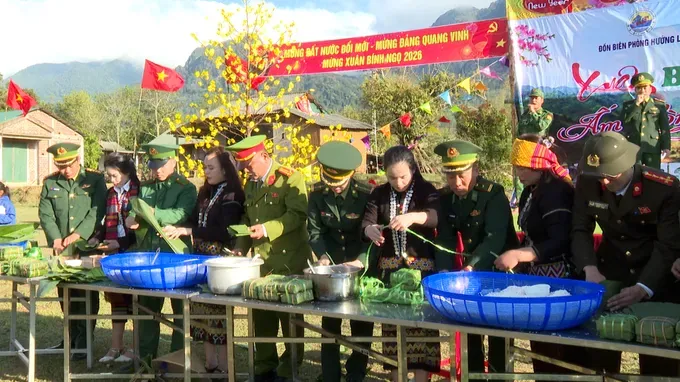
Nearly 200 kilometers from Da Nang City, in the border commune of Huong Lap (Quang Tri Province), the Tet atmosphere also arrived early in a different way. Laughter echoed throughout the villages as the program “Border Spring – Warming Villagers’ Hearts” was organized.
In the courtyard of the cultural house, students from La Co Boarding Junior High School (Sepon District, Savannakhet Province, Laos) watched intently as Vietnamese border guards deftly arranged dong leaves, pork, and sticky rice to wrap banh chung. For many students, this was the first time they had witnessed and directly participated in this Vietnamese Tet custom.
Souk Thi Da, a student at La Co Boarding Junior High School, was initially surprised but quickly integrated after being guided by the border guards. The student shared that behind the square banh chung is a story of gratitude to ancestors and the Vietnamese spirit of reunion. “I am really looking forward to tasting the cake I wrapped myself,” Souk Thi Da said with a smile.
The program became even more lively with folk games and contests for wrapping and cooking banh chung. The organizing committee awarded 1,000 Tet gifts to policy beneficiary families, poor households, and lonely elderly people in Huong Lap Commune and the opposing villages in Laos. They also awarded scholarships to students at La Co Boarding Junior High School and supported the construction of the “Sentiments at Vietnam-Laos Border” project.
These activities not only care for the material and spiritual lives of border residents during Tet but also serve as vivid proof of the close relationship between the military and the people. From the green banh chung and simple Tet gifts, the special solidarity and friendship between Vietnam and Laos are naturally cultivated and increasingly strengthened, contributing to maintaining stability and security in the border region.