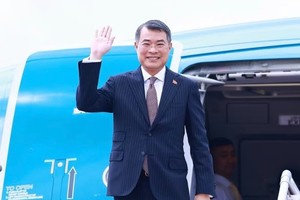
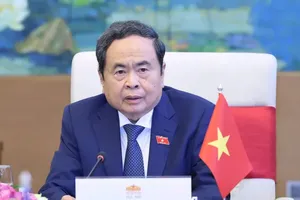
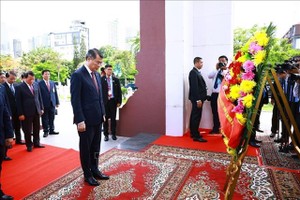
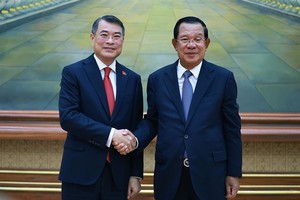
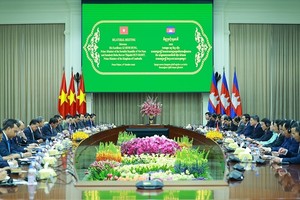
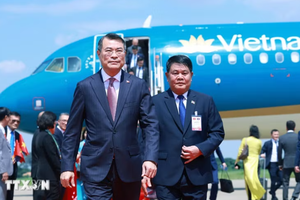
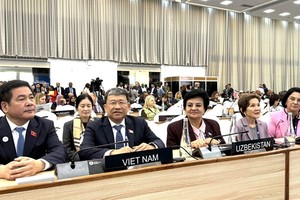
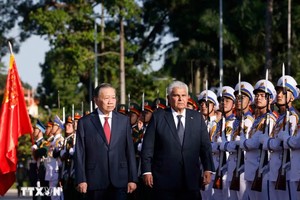
The visit is expected to help further consolidate and develop bilateral relations by strengthening cooperation through parliamentary channels.
The highest-level mechanism for inter-parliamentary cooperation
According to the Ministry of Foreign Affairs, this is National Assembly Chairman Tran Thanh Man’s first visit to China in his current capacity. The visit is a highly important diplomatic event aimed at further translating the foreign policy guidelines adopted at the 14th National Congress of the Communist Party of Vietnam into concrete action, particularly by enhancing the effectiveness of cooperation between the National Assembly of Vietnam and the National People’s Congress of China. It also underscores the pivotal role of parliamentary cooperation in the overall Vietnam-China Comprehensive Strategic Cooperative Partnership.
At the invitation of Zhao Leji, Chairman of the Standing Committee of the National People’s Congress of China, National Assembly Chairman Tran Thanh Man will pay an official visit to China and co-chair the second session of the Cooperation Committee between the National Assembly of Vietnam and the National People’s Congress of China from October 11 to 15.
The centrepiece of the visit will be the second session of the Cooperation Committee between the National Assembly of Vietnam and the National People’s Congress of China. Established in 2024, the committee is a new mechanism and the highest-level inter-parliamentary cooperation mechanism that either side has established with only a few other countries worldwide.
Permanent Deputy Minister of Foreign Affairs Nguyen Minh Vu said the session would be a substantive undertaking, providing an opportunity for the two legislative bodies to exchange views and translate orientations into concrete measures to strengthen coordination and create an even more favorable legal framework for bilateral cooperation. The two sides will also jointly monitor and urge the implementation of common understandings and agreements reached at various levels, particularly those secured during the highly successful state visit to China by Party General Secretary and State President To Lam in April.
Expressing high expectations for National Assembly Chairman Tran Thanh Man’s visit, Vietnamese Ambassador to China Pham Thanh Binh voiced confidence that, through the second session, the two sides would review the implementation of agreed initiatives and identify key cooperation priorities for the coming period. They would also step up exchanges between specialized agencies, share experience in legislation, oversight and decision-making on major national issues, and improve institutional frameworks to support development.
Expanding strategic connectivity and boosting cooperation
National Assembly Chairman Tran Thanh Man’s visit comes as Vietnam–China friendly relations develop strongly, achieving encouraging results across various sectors and bringing practical benefits to the people of both nations. Notably, cooperation in trade, investment, and tourism remains a bright spot in bilateral ties.
Vietnam has maintained its position as China’s largest trading partner within ASEAN for 10 consecutive years and, for two consecutive years (2024 and 2025), ranked as China’s fourth-largest trading partner globally.
Conversely, China has been Vietnam’s largest trading partner for 20 straight years. Chinese investment in Vietnam continues its upward trajectory. In the first seven months of 2026, total registered capital from Chinese investors reached nearly US$3.7 billion, an increase of 31.5 percent.
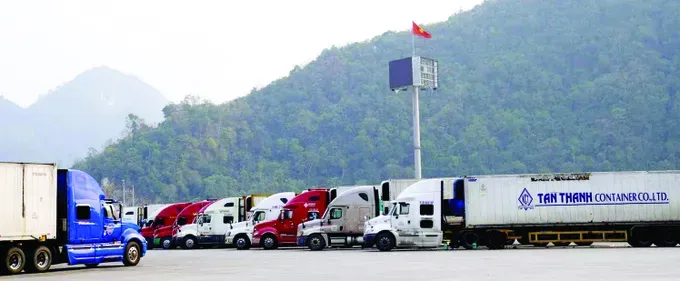
According to information from the Ministry of Foreign Affairs, during preparatory discussions for National Assembly Chairman Tran Thanh Man’s visit to China, both sides identified substantive focus areas, including enhancing strategic transport connectivity, developing smart border crossings, constructing cross-border economic zones, strengthening urban governance, reinforcing social and people-to-people foundations, and sharing experiences and cooperation opportunities in science and technology.
According to Deputy Minister Nguyen Minh Vu, China is a leading country in these fields and can share its development experience while helping both sides enhance mutual understanding, thereby facilitating bilateral cooperation in economics, trade, and investment, as well as new collaborative areas such as science and technology, innovation, artificial intelligence (AI) cooperation, high-quality human resource training, smart urban development, and green and circular economic growth.
At a recent reception in Hanoi celebrating the 77th National Day of China, Charge d'Affaires of the Chinese Embassy in Vietnam Wang Qun shared that China is ready to stand alongside Vietnam, making continuous efforts for the industrialization, modernization, and socialist construction of both countries. With high-quality and mutually beneficial cooperation, the two nations will jointly write a new chapter in building a China–Vietnam Community with a Shared Future that carries strategic significance at a higher level.
Ambassador Pham Thanh Binh noted that National Assembly Chairman Tran Thanh Man’s visit to China will continue to leverage the role of the two legislative bodies in establishing a legal corridor and supervising the implementation of substantive cooperation agreements and projects between the two countries. Activities within the framework of the visit will also help both sides promptly identify and assist in resolving legal and policy hurdles, promoting strategic connectivity in development, particularly in infrastructure connection, economics and trade, investment, science and technology, innovation, digital transformation, and human resource training on the basis of equality and mutual benefit.
In the first seven months of 2026, China was Vietnam’s largest trading partner, with bilateral trade turnover reaching US$184.2 billion, presenting an increase of 35.1 percent. Of this total, Vietnam exported over US$45.6 billion, showing an increase of 30.9 percent, and imported US$138.6 billion, presenting an increase of 36 percent, resulting in a trade deficit for Vietnam of approximately US$93 billion, showing an increase of 39.6 percent.
China ranked first in the number of new investment projects with 849 projects, accounting for 35 percent of total newly registered foreign direct investment projects in Vietnam. Cumulatively as of late July 2026, China had over 7,000 active projects with total registered capital of nearly US$37 billion, ranking 6th out of 153 countries and territories investing in Vietnam.
In the first eight months of 2026, Vietnam welcomed 3.54 million Chinese tourist arrivals, an increase of over 100 percent year-on-year, accounting for more than 22 percent of total international visitors and ranking first among foreign source markets for Vietnam.